

Banks in Kenya can legally freeze customer accounts under a structured framework that combines anti-money laundering laws, tax enforcement powers, judicial orders, and internal banking controls. The process is designed to stop the movement of suspected illicit funds, recover unpaid taxes, or preserve assets during disputes.
Regulatory Freezes Without an Initial Court Order
Certain state agencies have statutory authority to temporarily halt transactions before formal court proceedings begin. These powers are intended to prevent rapid dissipation of funds while investigations are underway.
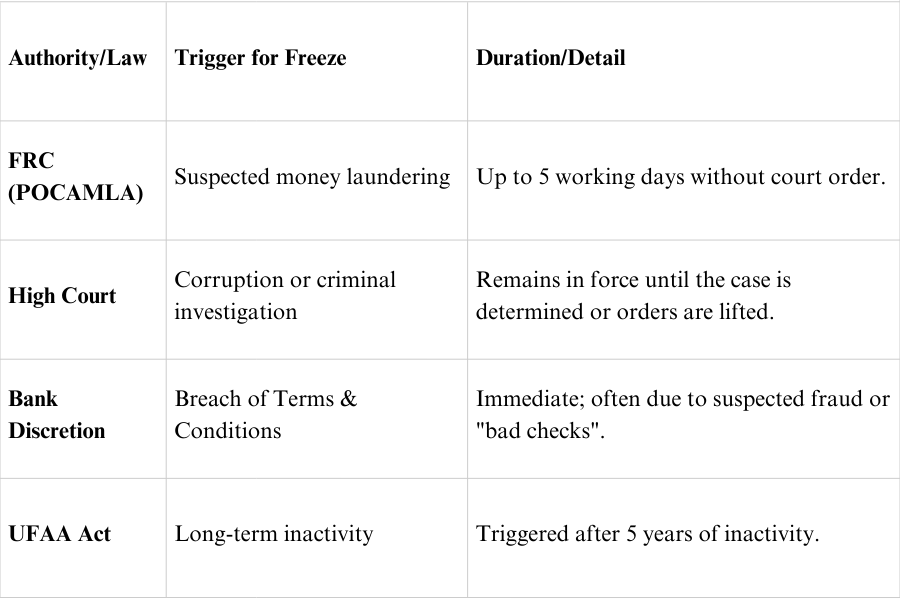
Under the Proceeds of Crime and Anti-Money Laundering Act (POCAMLA), the Financial Reporting Centre (FRC) may direct a bank to suspend transactions for up to five working days if there is reasonable suspicion of money laundering or terrorism financing. During this period, investigators determine whether further legal action is warranted.
Separate anti-terrorism regulations allow for immediate asset freezes where an individual or entity appears on the National Domestic List. These orders are executed quickly to block access to funds suspected of financing prohibited activities.
Tax enforcement represents another pathway for regulatory freezes. The Kenya Revenue Authority (KRA) can issue an Agency Notice to a bank, instructing it to hold funds belonging to a taxpayer with outstanding liabilities. This mechanism allows direct recovery of unpaid taxes from bank balances. Increased digital monitoring of transaction records has shortened the time between detection of discrepancies and enforcement action.
Court-Ordered Judicial Freezes
Longer-term freezes typically require judicial oversight. Courts intervene when assets must be preserved pending investigation, litigation, or settlement.
High Court preservation orders are used to secure funds suspected to be proceeds of crime or corruption. Once issued, withdrawals are blocked until investigations conclude or the court lifts the restriction.
Creditors may also obtain garnishee orders after winning a civil claim. In this scenario, a bank freezes an amount equal to the judgment debt and releases it to the creditor under court supervision.
Civil and family disputes create another category of judicial freezes. Courts may temporarily restrict access to joint or contested accounts during divorce proceedings or inheritance cases to prevent depletion of shared assets.
Bank-Initiated Administrative Freezes
Banks retain contractual authority to restrict accounts when compliance or risk concerns arise. These freezes are not punitive but are tied to regulatory obligations and fraud prevention.
Know Your Customer (KYC) rules require customers to maintain up-to-date identification and source-of-funds documentation. Failure to comply may result in restricted access until verification is completed.
Transaction monitoring systems automatically flag unusual activity — such as rapid large transfers or cross-border inflows inconsistent with account history. Banks may pause transactions for internal review and, where required, escalate the matter to the FRC.
Dormancy rules create another administrative restriction. Accounts with extended inactivity are marked dormant, limiting electronic access. If inactivity persists for five years, banks must transfer balances to the Unclaimed Financial Assets Authority under statutory requirements.
Duration and Path to Recovery
Freeze periods vary depending on legal basis and investigative needs.
Temporary administrative holds often last days to a few weeks while documentation is verified. Regulatory freezes may extend if authorities seek court authorization. Judicial orders can remain in effect for months or longer, depending on case progress.
Restoring access usually depends on satisfying the authority that imposed the restriction. Customers may need to submit verification documents, resolve tax liabilities, or seek court review through an inter-partes hearing. Legal counsel is often required where court orders are involved.
What Customers Should Do Immediately
A frozen account is not automatically evidence of wrongdoing. In many cases, it signals a compliance or documentation issue that can be resolved quickly.
Customers should first contact their bank to obtain the legal basis for the restriction. Where documentation is requested, timely submission can shorten the freeze period. If the restriction stems from a court order or regulatory action, legal advice becomes essential to determine available remedies.
Jefferson Wachira is a writer at Africa Digest News, specializing in banking and finance trends, and their impact on African economies.