
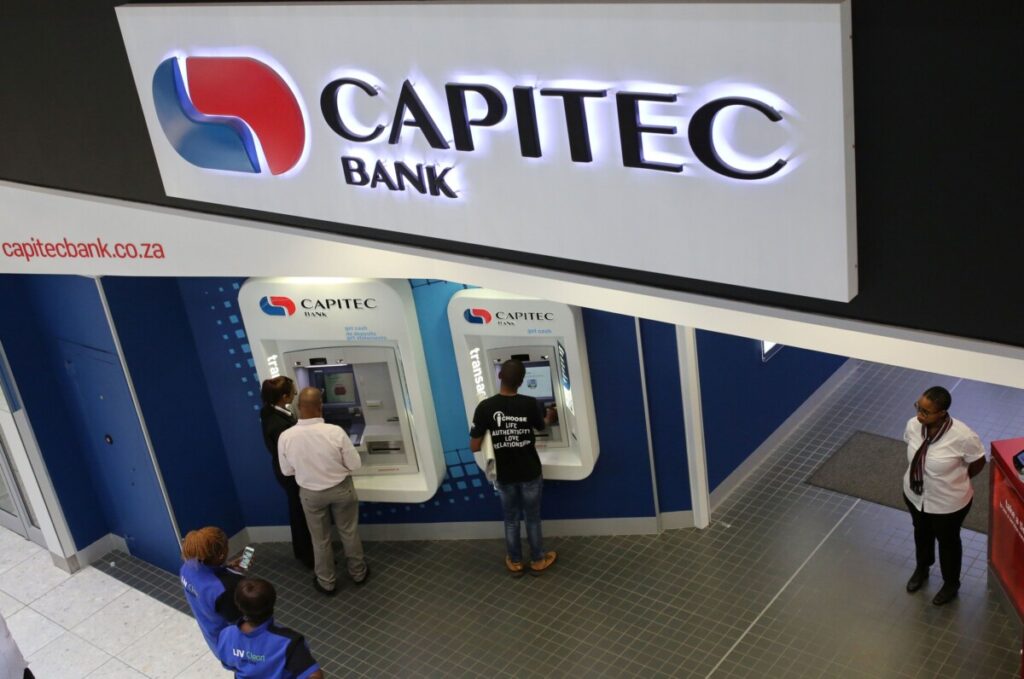
Capitec has emerged as Africa’s most valuable listed bank by market capitalization, overtaking regional peers FirstRand and Standard Bank in a ranking that highlights investor preference for South African lenders and the growing weight of retail-focused banking models.
Market data compiled in mid-February shows Capitec valued at about $33.72 billion, narrowly ahead of FirstRand at roughly $33.22 billion and Standard Bank at $31.81 billion. The trio forms a clear top tier among African banks by equity valuation, with a sizeable gap separating them from the next group of lenders.
The ranking places Morocco’s Attijariwafa Bank fourth at about $16.52 billion, followed by Absa Group at $13.6 billion and Nedbank at $8.21 billion. Trade-focused Afreximbank, Morocco’s Banque Centrale Populaire, Bank of Africa, and Malawi-based FMBcapital round out the top ten, each with market capitalizations below $7 billion.
Retail banking model drives valuation premium
Capitec’s rise to the top of the list comes as investors continue to reward banks that demonstrate scalable retail franchises, strong digital adoption, and consistent earnings delivery. The bank has built its business around simplified products, high transaction volumes, and technology-led distribution, enabling it to grow customer numbers while maintaining cost discipline.
Equity analysts say this operating model has translated into predictable revenue streams and strong return metrics, factors that typically support higher valuation multiples in banking stocks. Compared with more diversified universal banks, retail-heavy lenders can generate steady fee income and lending margins when credit quality remains contained.
FirstRand and Standard Bank, while larger in asset terms and more geographically diversified, face more complex operating environments spanning corporate banking, investment banking, and cross-border exposure. Their valuations still rank among the highest on the continent, supported by scale, diversified income sources, and established regional networks.
South African banks dominate continental rankings
South Africa’s outsized presence at the top of the market-cap table points to the depth and liquidity of its capital markets relative to most African peers. The country’s banking sector benefits from mature regulatory oversight, broad investor participation, and well-developed financial infrastructure, factors that tend to support consistent access to equity capital.
Local banks also operate in a highly competitive environment that has accelerated digital investment and product innovation. Mobile-first services, data-driven credit assessment, and integrated payment ecosystems have become core features of South African banking, helping institutions retain customers and expand fee-based services.
By contrast, banks in other African markets often contend with thinner trading volumes, currency volatility, and narrower investor bases, which can weigh on valuations even when operational performance is solid.
Mid-tier lenders show regional diversity
Outside South Africa, the rankings highlight North and pan-African institutions with strong regional footprints. Attijariwafa Bank’s valuation places it as the highest-ranked lender outside South Africa, supported by operations across North and West Africa. Afreximbank’s inclusion underscores investor interest in trade finance and development-oriented banking models tied to cross-border commerce.
Banks such as Banque Centrale Populaire, Bank of Africa, and FMBcapital illustrate the diversity of Africa’s banking landscape, spanning francophone West Africa, North Africa, and Southern Africa. Their smaller market capitalizations do not necessarily indicate limited reach, but rather differences in listing venues, free float, and investor access.
What the valuations signal
Market capitalization offers a view of how investors price future earnings and growth, rather than a direct measure of a bank’s assets or profitability. The latest rankings show a premium for lenders with predictable revenue streams, tight cost control, and digitally scalable operations.
For executives, higher valuations can reduce funding costs and make equity a more flexible tool for acquisitions or expansion. Investors, meanwhile, see South Africa’s top-tier banks as a central entry point to African financial markets, while mid-tier institutions offer exposure to trade finance, regional retail growth, and niche segments.
Jefferson Wachira is a writer at Africa Digest News, specializing in banking and finance trends, and their impact on African economies.