

Commercial banks in Kenya are increasing their physical branch networks after years of consolidation, as lenders combine digital banking with targeted in-person services to reach new customers in suburban and rural areas.
The expansion comes despite the dominance of digital channels, where more than 90% of transactions are completed through mobile and internet platforms. Banks say physical outlets still play a role in onboarding customers, handling high-value transactions and supporting small businesses that rely on cash deposits.
Data from the Central Bank of Kenya show that the number of commercial bank branches rose from 1,475 in 2022 to 1,511 in 2023, with further expansion through 2024 and 2025. By late 2024, the total network had reached about 1,573 banking halls.
Commercial lenders opened 62 new branches in 2024 alone, the largest annual increase since 2015, according to industry data compiled from central bank disclosures.
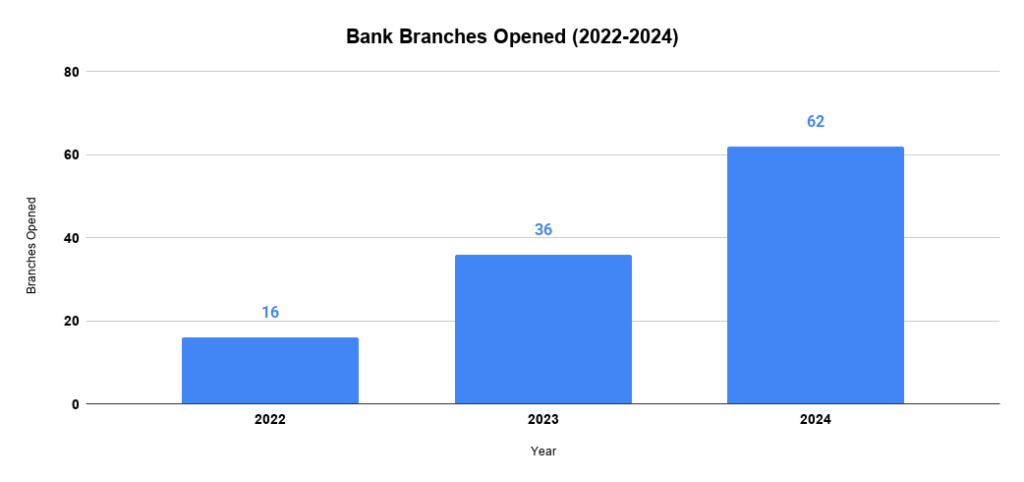
Expansion Focused on Growth Corridors
Nairobi remains the largest banking hub with about 588 branches, while counties such as Kiambu County recorded the fastest growth, adding nine new outlets. Expansion has also increased in Mombasa and Uasin Gishu County, areas linked to trade and agricultural activity.
Lenders say the focus on emerging towns is designed to capture new retail and small-business customers outside traditional city centres.
Co-operative Bank of Kenya added eight branches in 2023 and 16 more in 2024. I&M Bank has said it intends to reach 79 branches by 2026, opening new outlets in towns such as Mtwapa, Kawangware, Nyali and Kapsabet during 2025. Equity Group Holdings expanded its footprint with new locations in counties including Bungoma, Kajiado, Mombasa and Kitui in July 2025. Absa Bank Kenya opened its 87th branch in Kawangware in July 2025.
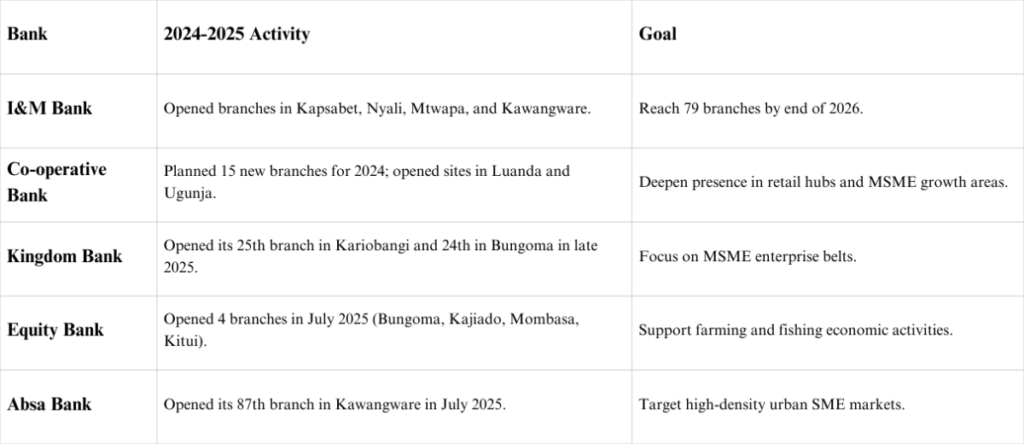
The expansion also includes smaller outlets designed to handle advisory services and cash deposits rather than high-volume teller transactions.
Hybrid Banking Model
Banks describe the approach as “phygital” banking, combining physical infrastructure with digital platforms. Mobile apps and internet banking handle routine payments, transfers and account monitoring. Branches are increasingly used for services that require consultation, such as mortgages, wealth management, and corporate lending.
Small and medium-sized businesses are also a focus. Bank executives say SME operators frequently prefer in-person engagement when applying for credit or depositing large amounts of cash.
Even institutions with high digital adoption rates continue to maintain physical networks. KCB Group reports that about 99% of its transactions occur outside branches, yet the lender continues to operate a large branch footprint for onboarding and advisory services.
Cash Still Shapes Demand
Kenya remains heavily cash-dependent in parts of the economy, particularly among small traders and agricultural producers who deposit physical revenue. Branches therefore act as access points for bulk deposits and withdrawals that cannot easily be processed through mobile money agents. Some customers have also shifted to ATM withdrawals after the introduction of taxes on certain mobile money transactions, increasing demand for bank-based cash services.
In rural and semi-urban areas, a visible branch presence can also build trust among first-time account holders who prefer face-to-face engagement before adopting digital tools.
Regulatory Changes and Competition
In July 2025, the Central Bank of Kenya lifted a decade-long moratorium on licensing new commercial banks. The move is expected to increase competition for deposits and lending customers, which could lead to additional branch openings in the coming years.
At the same time, new capital requirements will raise the minimum core capital threshold for banks to 10 billion shillings by 2029. Analysts say the rule could prompt consolidation among smaller lenders even as larger banks continue expanding their networks.
Jefferson Wachira is a writer at Africa Digest News, specializing in banking and finance trends, and their impact on African economies.