
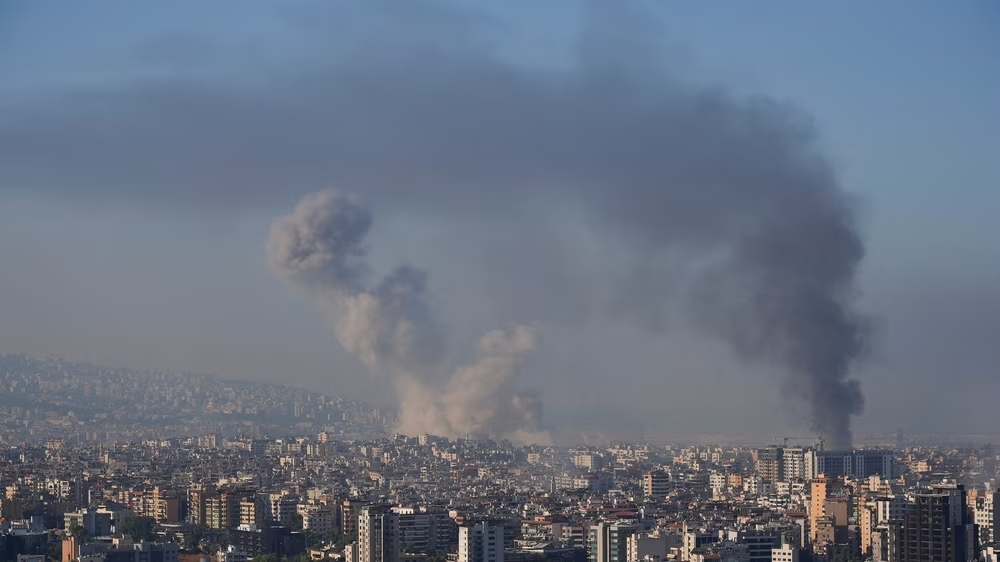
Kenyans may soon begin to feel the economic reverberations of the escalating conflict between the United States, Israel, and Iran, which has entered its eighth day. The Strait of Hormuz, the world’s most critical energy chokepoint, is effectively closed as of early March 2026. Normally, this narrow waterway facilitates the transit of roughly 20–21 million barrels of oil per day, representing about 20 percent of global consumption.
Commercial traffic through the Strait has nearly stopped, with major shipping companies, including Maersk, MSC, Hapag-Lloyd, and CMA CGM, suspending all transits following repeated missile and drone strikes by Iran. The surge in war-risk insurance premiums has further compounded the disruption, with some insurers refusing coverage entirely for vessels entering the Gulf. Physical hostilities have already damaged at least eight commercial vessels, causing fatalities and multiple injuries. Around 150 tankers are currently stranded or anchored outside the Strait, unable to safely enter or exit the Persian Gulf.
Kenya’s Reliance on the Strait of Hormuz
Every drop of Kenya’s petroleum imported under its primary supply agreement transits through the Strait of Hormuz before reaching the Port of Mombasa. This makes the country 100% reliant on this single waterway for its current structured fuel supply.
The country sources its fuel primarily from Saudi Arabia, the UAE, and Kuwait through government-to-government agreements with Saudi Aramco, ADNOC, and ENOC. Petroleum represents nearly a quarter of Kenya’s total import costs, making uninterrupted supply crucial for both domestic consumption and regional obligations to landlocked neighbors such as Uganda and Rwanda.
When Kenyans May Feel the Effects
Energy and Petroleum Cabinet Secretary Opiyo Wandayi confirmed on March 3, 2026, that Kenya currently holds adequate petroleum reserves to meet domestic demand and maintain regional supply obligations. Scheduled imports under the G-to-G framework are in place through April, providing a temporary buffer against global spot market volatility. Officials indicated that strategic reserves had been bolstered in previous quarters in anticipation of potential supply chain disruptions, giving Kenya some protection against immediate price shocks.
Nevertheless, the economic impact is expected in phases. In the immediate term, shipping surcharges and speculative buying could raise costs for other imported goods, including electronics and machinery, even before fuel prices are directly affected. By mid-April, the Energy and Petroleum Regulatory Authority (EPRA) will incorporate higher landed costs into its pricing, though government G-to-G agreements may limit extreme spikes.
Experts warn that if the Strait remains closed beyond April, pre-conflict fuel stocks will be exhausted. Global crude prices could rise to $100–$120 per barrel, driving up transport, electricity, and food distribution costs across Kenya. The government is reportedly exploring alternative loading ports and sourcing from North and West Africa to reduce reliance on the Strait.
Government Response
Several Kenyan officials have addressed the potential fallout from the conflict. President William Ruto condemned the regionalization of hostilities, warning of risks to energy security and trade, and called for urgent diplomatic engagement. Treasury CS John Mbadi highlighted the potential economic disruption, comparing it to the effects of the COVID-19 pandemic.
Prime Cabinet Secretary and Foreign Affairs CS Musalia Mudavadi emphasized the likelihood of inflationary pressures and fuel price volatility if instability persists. Trade CS Lee Kinyanjui drew attention to the risk to Kenya’s export basket, including tea, coffee, flowers, and horticultural products worth over KSh 700 billion, while Diaspora Affairs PS Roseline Njogu urged Kenyans in the Middle East to register with diplomatic missions for monitoring and safety.
Global Oil Trade Impacts
The disruption is creating ripple effects across global energy markets. Roughly 15–20 percent of the world’s daily oil supply and 20 percent of liquefied natural gas is trapped in the Gulf. Brent crude surged to $82–$84 per barrel within the first days of the conflict, and analysts warn that prolonged disruption could push prices to $100–$150 per barrel.
Asia is particularly exposed, as over 84 percent of the oil transiting the Strait is destined for Chinese, Indian, Japanese, and South Korean ports. While Saudi Arabia and the UAE have pipelines that bypass the Strait, their combined capacity can only offset a fraction of the blocked supply. Cargo ships are increasingly being rerouted around Africa’s Cape of Good Hope, adding 10–15 days to transit times and driving up freight and fuel costs.
Conflict Overview
The Iran‑Israel/US conflict, which began on February 28, 2026, represents a significant escalation from decades of low-intensity proxy conflicts. The United States and Israel launched coordinated airstrikes targeting Iranian nuclear facilities, air defenses, and command centers, killing Supreme Leader Ali Khamenei, the defense minister, and top IRGC commanders. The objective is to dismantle Iran’s nuclear and missile programs and instigate regime change. Iran has retaliated with ballistic missiles and drone strikes across Israel, U.S. bases in the Gulf, and neighboring states, effectively closing the Strait of Hormuz.
As of March 6, 2026, Iranian missile and drone activity has decreased by 83–90 percent according to U.S. Central Command. Coalition forces are now focusing on underground missile storage and defense industrial assets. In the United States, Congress failed to pass a resolution to limit the continuation of military operations, and the administration is aiming for a rapid conclusion.
Jefferson Wachira is a writer at Africa Digest News, specializing in banking and finance trends, and their impact on African economies.