
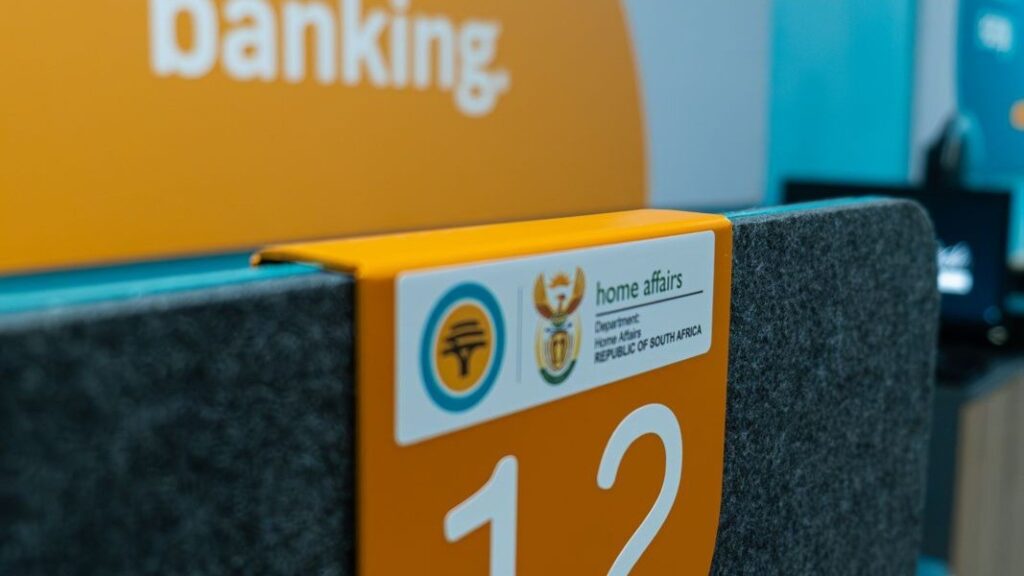
Banks are expanding Smart ID services in South Africa as part of a new digital partnership with the Department of Home Affairs (DHA), aimed at modernising identity services and addressing long-standing application backlogs at government offices.
Institutions including Standard Bank Group, First National Bank (FNB), and Capitec Bank have begun scaling access to Smart ID cards through their branch networks following the launch of the Digital Partnership Model in March 2026. The programme connects banks directly to DHA systems through a secure digital interface, enabling customers to apply for identity documents from participating bank branches rather than visiting Home Affairs offices.
The expansion comes as the government accelerates its effort to replace the country’s green barcoded identity book with the biometric Smart ID card, which offers stronger security features and improved protection against identity fraud.
Government Push to Modernise Identity Services
The DHA introduced the new partnership framework to expand the number of service locations and reduce pressure on public offices. Under the model, banks connect to government systems through a secure digital API gateway that enables real-time processing of Smart ID applications.
According to Home Affairs Minister Leon Schreiber, the partnership expands access to identity services while strengthening the country’s national identity system.
“By securely connecting trusted institutions such as banks directly to Home Affairs systems, we are expanding access to Smart ID services while strengthening the integrity of South Africa’s national identity system. This is how we build a modern, digital Home Affairs that delivers services with greater security, convenience and dignity, closer to where people live. This is Home Affairs at home in action.” Schreiber said during the programme launch.
The government plans to scale the partnership from roughly 30 operational locations today to around 1,000 bank branches by 2029, extending coverage to underserved and rural communities.
Standard Bank Begins Branch Rollout
Standard Bank Group launched the service at its branch in Maponya Mall as part of the initial phase of the programme. The bank plans to add 20 more branches in early 2026. During the first stage, Smart ID services are available at selected branches including Maponya Mall in Soweto, Rosebank and Westgate in Johannesburg, and Parow in Cape Town.
Customers can apply to convert their green ID books into Smart ID cards or replace lost, stolen or damaged cards at the branch, with biometric information captured on site.
Funeka Montjane, CEO of Standard Bank Personal and Private Banking, said access to identity services is closely linked to economic participation.
“Access to secure identity services is fundamental to economic participation. By working with the Department of Home Affairs, we are bringing these services closer to where people live and work, using infrastructure that communities already trust,” Montjane said.
The bank is not charging customers for accessing the service during the launch phase.
FNB Expands Smart ID Network
First National Bank (FNB) has also confirmed plans to expand Smart ID services in South Africa through its branch network after completing initial system testing.
Chief executive Harry Kellan said the initiative builds on the bank’s long-running collaboration with the DHA.
“We are incredibly proud to be part of this initiative and look forward to going live with this expanded capability. I want to commend the dedicated teams across FNB and our partners who have worked tirelessly to bring this to life. Smart ID Cards are essential for accessing vital services, securing employment, and participating fully in the economy. With the DHA’s modernised technology, we can now reach millions more South Africans through our infrastructure and that is what real help is all about.” Kellan said.
FNB plans to scale the service to more than 240 branches within a year. The bank has already issued more than 570,000 Smart IDs and passports through seven branches since 2015, including over 258,000 Smart IDs and more than 312,000 passports.
Zibu Nqala, CEO of FNB Points of Presence, said the branch network helps extend access to communities that struggle to reach Home Affairs offices.
“Our branch network plays a vital role in reaching communities that have historically struggled to access Home Affairs services. This expansion will allow us to bring essential identity solutions closer to our customers’ doorsteps, ensuring inclusive access regardless of where they live.” Nqala said.
Capitec Targets Hundreds of Branches
Capitec Bank has begun rolling out Smart ID services through dedicated in-branch self-service terminals that allow customers to complete applications digitally. Following a pilot phase, the bank plans to expand the service to 100 branches by mid-2026 and about 300 by the end of the year. The application process takes less than five minutes and is integrated directly with DHA systems. Customers receive a notification once their Smart ID is ready for collection at the branch.
Home Affairs estimates that more than 4.4 million South Africans over the age of 16 do not have either a green ID book or a Smart ID card, creating barriers to employment, voting and financial services.
Capitec CEO Graham Lee said identity documents play a central role in enabling economic participation.
“An ID is a catalyst for economic participation. We serve close to half of South Africa’s adult population, and we know that time is our clients’ most valuable asset. By integrating Home Affairs services into our branches, we are using our scale and technology to shorten long journeys and help fill a real gap in underserved communities.” Lee said.
Why Smart ID Services Are Expanding in South Africa
One of the most urgent issues driving the rapid expansion of Smart ID services in South Africa is fraud. About 16 million South Africans still use the green barcoded ID book, which is widely considered easier to counterfeit than the biometric Smart ID card.
The new digital partnership model also allows banks to process applications without requiring DHA staff to be physically stationed inside branches. Banks can instead use their own trained employees and digital systems to capture biometrics and submit applications directly to government systems.
Convenience is another factor. Long queues and travel distances have often limited access to identity services, especially in rural areas. By using existing bank infrastructure, the government can increase the number of service points without building additional offices.
Banks also see identity services as part of financial inclusion. Individuals without official identification often cannot open bank accounts, apply for credit, or access formal employment.
More Banks Join the Programme
In addition to Standard Bank, FNB and Capitec, several other institutions have signed up to the DHA’s digital partnership model, including Absa Group, Old Mutual, Discovery Bank, TymeBank, Nedbank Group and African Bank.
If fully implemented, the programme could create one of the largest distributed identity-service networks in the country, using commercial bank branches to handle millions of applications each year.
Jefferson Wachira is a writer at Africa Digest News, specializing in banking and finance trends, and their impact on African economies.