
The 2025 Brand Finance Kenya 100 report ranks the most valuable brands in the country, produced by Brand Finance, a London-based independent brand valuation and strategy consultancy. Brand Finance uses a methodology called the Royalty Relief approach, which estimates how much a company would need to pay to license its own brand if it didn’t own it.
The process begins by calculating a Brand Strength Index (BSI), a score from 0 to 100 that evaluates marketing investment, stakeholder equity, and business performance. This BSI determines the brand’s royalty rate based on sector norms, which is then applied to forecasted brand revenues over a five-year period. The resulting figures are discounted to present value to calculate the final brand valuation. The methodology follows international standards ISO 10668 (monetary valuation) and ISO 20671 (brand evaluation).
The following five companies are the most valuable Kenyan brands according to the 2025 Brand Finance Kenya 100 report:
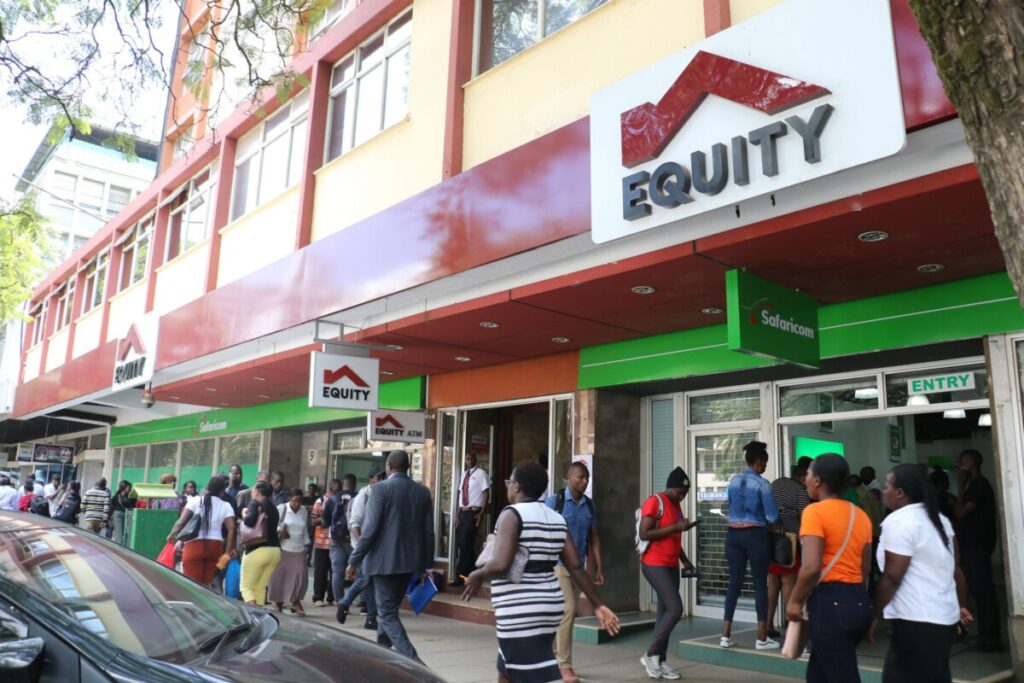
1. Equity Bank – $554M (KSh 71.3B)
Equity Bank’s brand strength comes from financial inclusion, digital innovation, and regional expansion. Founded to serve the unbanked, it created deep loyalty by targeting small-scale farmers, informal traders, and micro-entrepreneurs in the 1990s and early 2000s. The bank’s digital ecosystem, anchored by EazzyBanking and Equity Mobile, has moved over 90% of transactions online, appealing to younger, tech-savvy customers.
Its “Twin Engine” strategy combines traditional banking with social impact initiatives, reinforcing the brand’s reputation beyond profits. Expansion across six African countries, including the acquisition of BCDC in Congo, strengthened regional visibility. A Brand Strength Index (BSI) score of 90.7 reflects trust, supported by programs like the Wings to Fly scholarship, while strong financials, with assets over KSh 1.5 trillion, underlie the $554 million valuation.
2. Safaricom – $453M (KSh 58.3B)
Safaricom’s value is driven by M-PESA, which handles billions of transactions annually and has become essential to Kenya’s economy. Extensive 4G and 5G coverage reaches over 99% of the population, ensuring network reliability and premium pricing.
Safaricom has shifted from a telecom operator to a technology platform, integrating services such as M-Shwari, DigiFarm, and travel solutions. The company’s consistent profitability allows significant investment in marketing and innovation, keeping the brand highly visible.
3. KCB Group – $426M (KSh 54.8B)
KCB Group combines historical credibility with modern banking innovations. Founded in 1896, it has transformed from a government-backed bank into a pan-African institution. Regional expansion through acquisitions of Trust Merchant Bank (DRC) and BPR Rwanda extended its footprint in East and Central Africa.
The launch of KCB M-PESA enabled millions of unbanked customers to access credit, making the brand widely recognized. KCB’s management of government payrolls and large infrastructure projects positions it as a trusted partner for corporate and public sector banking.
4. M-PESA – $240M (KSh 30.8B)
M-PESA has become a standalone brand due to its widespread use and influence. In Kenya, it is synonymous with mobile money, giving it a rare level of brand recall. Beyond transfers, M-PESA functions as a full financial ecosystem with Lipa na M-PESA and global partnerships with Visa, PayPal, and Western Union.
Operating in multiple African markets, it is the primary revenue engine for Safaricom, rivaling standalone banks in transaction volume and profitability. Its reliability and accessibility contribute to a high Brand Strength Index.
5. Co-operative Bank – $202M (KSh 26.0B)
Co-operative Bank is distinguished by its cooperative ownership structure, creating loyalty among over 15 million SACCO members. The bank maintains high operational efficiency, producing strong profits with fewer branches than competitors.
Its subsidiary, Kingdom Bank, serves faith-based communities and micro-SMEs, while the M-Co-op Cash platform digitizes the SACCO network, connecting rural customers to modern banking services without physical branches.
Jefferson Wachira is a writer at Africa Digest News, specializing in banking and finance trends, and their impact on African economies.