
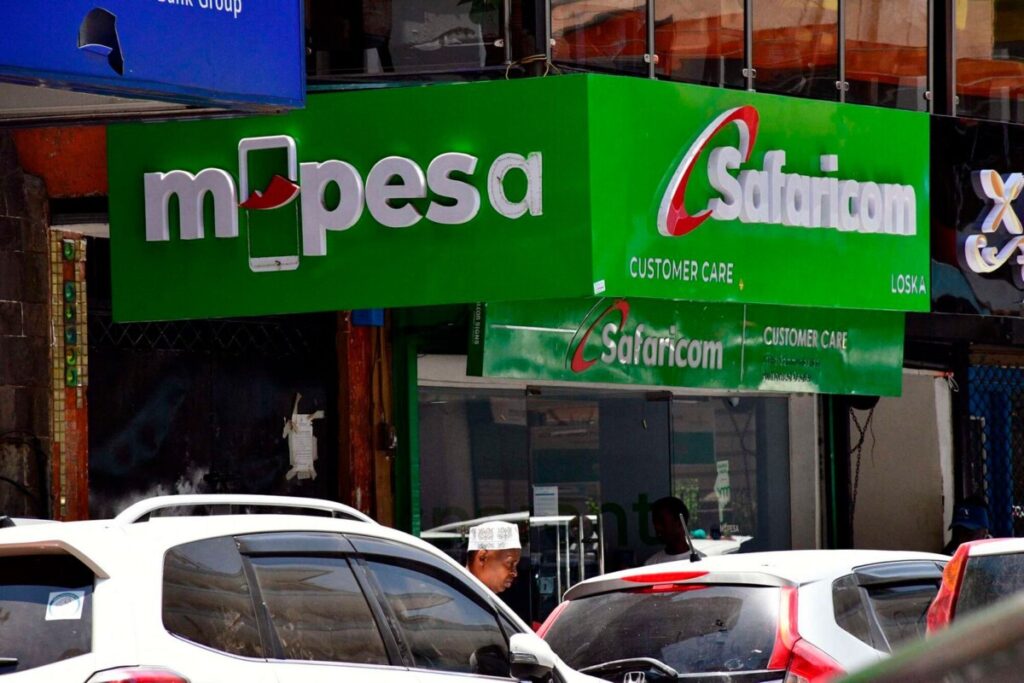
For nearly 20 years, M-PESA and Safaricom have been nearly inseparable in Kenya’s daily life. Walk into any town, and the omnipresent green shops, SIM cards, and mobile money agents all blur the line between telecom and finance. For many, M-PESA isn’t just a service, it is Safaricom. But despite this perception, the two are distinct brands, operating under the same corporate umbrella yet serving different purposes.
Shared Identity Fuels Confusion
Part of the reason people think M-Pesa and Safaricom are the same lies in branding. Almost every M-PESA agent shop is painted in Safaricom’s signature green. Marketing since M-PESA’s 2007 launch has always positioned it as a Safaricom service, and the M-PESA logo historically incorporates Safaricom’s red and green colors. This consistent visual and marketing alignment has made the two appear as one in the public eye.
Beyond branding, the operational setup has reinforced this perception. M-PESA historically required a Safaricom SIM card, tying the mobile money service to the telecom network. The platforms are converging digitally: the “MySafaricom” and “M-PESA” apps are being merged into a single “Super App,” offering users a unified experience. Most retail outlets selling airtime also serve as M-PESA agents, creating a single point of interaction for both services.
Language and trust play a role as well. “M-PESA” has become a verb in Kenya, often used to describe mobile money transfers regardless of provider. The service’s early adoption was aided by Safaricom’s existing reputation, which gave users confidence in the safety of digital money. This trust association further cements the perception that M-PESA and Safaricom are synonymous.
Corporate Reality: They Are Not the Same
Despite appearances, M-PESA is a subsidiary of Safaricom PLC. Safaricom and Vodacom acquired the M-PESA brand and intellectual property from Vodafone in 2020 via M-PESA Africa, and Safaricom fully acquired M-PESA Holding Company Limited in 2023, which manages customer funds. Financially, M-PESA drives a large portion of Safaricom’s revenue, about 44.2% of service income in early 2025, but it remains legally and operationally a distinct brand.
Safaricom focuses on telecommunications: voice, data, SMS, and home fiber. M-PESA is a fintech platform offering payments, loans, merchant solutions, and international transfers. Regulators have proposed formally splitting the two entities to improve oversight, but as of late 2025, they remain deeply intertwined.
Historical Roots Highlight Their Differences
Safaricom started in the 1990s as a government-owned mobile department within the Kenya Posts and Telecommunications Corporation. Privatized in 1997 and partially acquired by Vodafone in 2000, it went public in 2008, becoming Kenya’s largest IPO at the time.
M-PESA, on the other hand, was conceived from observing Kenyans using airtime as currency. Developed by Nick Hughes of Vodafone in 2003 and piloted in 2005, it launched commercially in 2007 with the tagline “Send Money Home.” Early products focused on microfinance, while later innovations such as M-Shwari (2012), Lipa na M-PESA (2013) and Fuliza (2019) expanded into banking and merchant services.
Why Confusion Persists
The confusion persists because M-PESA is built on Safaricom’s infrastructure. Transactions run through Safaricom’s SMS and USSD gateways, wallets are tied to SIM cards, and the platform now uses cloud-native systems capable of processing thousands of transactions per second. Loyalty programs like Bonga Points link financial activity with telecom usage, further blending the customer experience.
Even geographically, M-PESA and Safaricom are almost indistinguishable. Over 262,000 agents serve both services, reinforcing the mental image of a single brand. Combined marketing, app integration, and co-located services make the distinction largely invisible to the average user.
Jefferson Wachira is a writer at Africa Digest News, specializing in banking and finance trends, and their impact on African economies.