
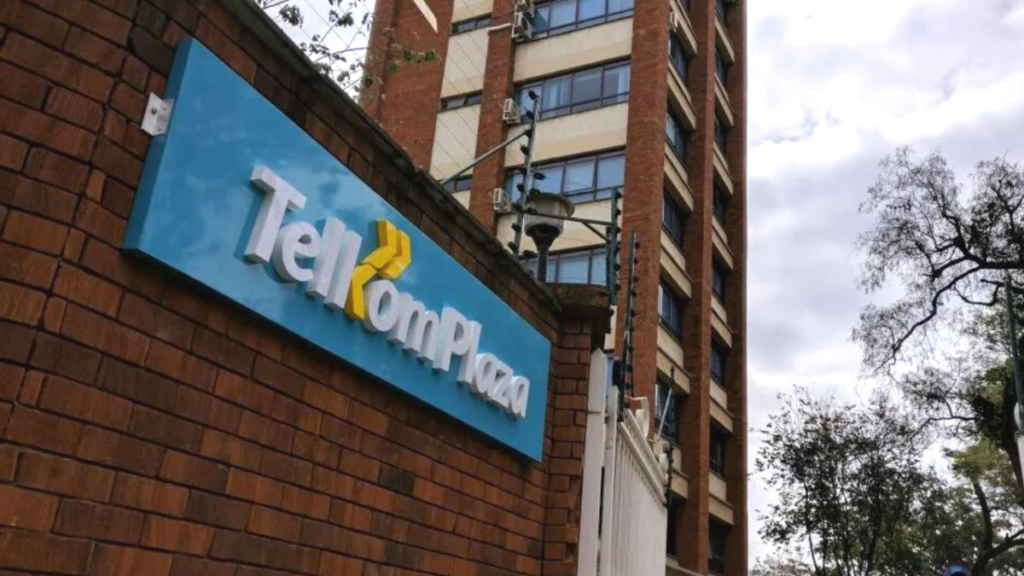
Telkom Kenya has fallen to become the fifth-largest mobile operator in Kenya, a dramatic shift from its third-place position just two years ago. The latest data from the Communications Authority of Kenya (CA) shows that as of April 2026, the operator’s subscriber base stands at approximately 744,902, representing a drop of 82% from an estimated 4.1 million in December 2021. Market share has contracted to around 1%, signaling a near-total erosion of Telkom’s earlier standing in the Kenyan telecom sector.
Several factors have contributed to the Telkom Kenya decline:
1. Network Performance and Infrastructure Failures
A major driver of Telkom’s fall has been its deteriorating network quality. The operator’s Quality of Service (QoS) score declined to 52.76% by April 2026, significantly below the CA’s regulatory benchmark of 80%. Dropped calls reached 6.86%, more than triple the permissible limit.
Poor network reliability has been a consistent reason cited by subscribers for switching to competitors. In contrast, operators such as Jamii Telecommunications Limited (JTL) have successfully attracted urban, high-data users through their Faiba brand, which offers affordable 4G connectivity and VoLTE services. Telkom’s inability to maintain stable network performance has been compounded by aging infrastructure, which has left the company struggling to compete in a market increasingly driven by high-speed data services.
2. Financial and Ownership Challenges
Telkom has faced prolonged financial uncertainty. The exit of Helios Investment Partners and the government’s subsequent buyback created a gap in capital availability that has restricted investment in network upgrades, including critical 4G and 5G deployment. This lack of investment has directly impacted Telkom’s ability to modernize its infrastructure and provide competitive service offerings.
Corporate uncertainty has also contributed to customer attrition. The combination of debt, limited investment, and unclear strategic direction has undermined confidence in the operator’s long-term viability, prompting users to migrate to more stable networks.
3. Regulatory Impacts
Regulatory changes have further accelerated Telkom’s subscriber losses. The tightening of SIM registration rules in 2022 led to the mass disconnection of inactive or non-compliant lines. Driven by the Communications Authority of Kenya (CA) to curb crime, the initiative demanded updated identification data, with new rules limiting individuals to 10 SIM cards.
Subscribers were required to provide accurate, up-to-date identification, such as IDs, passports, or birth certificates. Telkom’s already fragile subscriber base was disproportionately affected, reducing numbers more sharply than for larger or more active networks. The policy shift, aimed at improving compliance and security across the sector, inadvertently magnified Telkom’s decline.
4. Intensifying Competition
Telkom Kenya decline has been accelerated by mounting competitive pressures across the market. Safaricom, the largest mobile operator in Kenya, maintained its leading position with 52.4 million subscribers as of December 2025. The operator’s scale, extensive network coverage, and diversified mobile money services have allowed it to retain customer loyalty even as other players seek growth.
Airtel Kenya, with 22.9 million subscribers despite a decline of 1.1 million users, has narrowed the gap with Safaricom through targeted investments in 5G deployment and mobile money integration. By enhancing both network capacity and digital services, Airtel has strengthened its appeal to both urban and data-intensive users, leaving Telkom increasingly marginalized.
Equitel has leveraged its integration with Equity Bank to offer a combined telecom and financial services platform. This approach attracts subscribers seeking a digital ecosystem that Telkom’s T-Kash platform has been unable to match in utility or reach.
Meanwhile, Jamii Telecommunications Limited (JTL) has carved out a niche by targeting high-data “power users” with affordable 4G connectivity and VoLTE services under its Faiba brand. Between late 2025 and early 2026, JTL’s subscriber base grew by 7.1%, overtaking Telkom at a time when the state-owned operator lost 123,886 users. This combination of scale, digital integration, and niche-focused strategies has left Telkom struggling to defend its position in an increasingly competitive market.
Telkom’s low-cost strategy has proven insufficient as a differentiator. The operator no longer has a clear competitive advantage in pricing, service reliability, or digital offerings, leaving it vulnerable to both large-scale operators and agile niche players.
Jefferson Wachira is a writer at Africa Digest News, specializing in banking and finance trends, and their impact on African economies.