
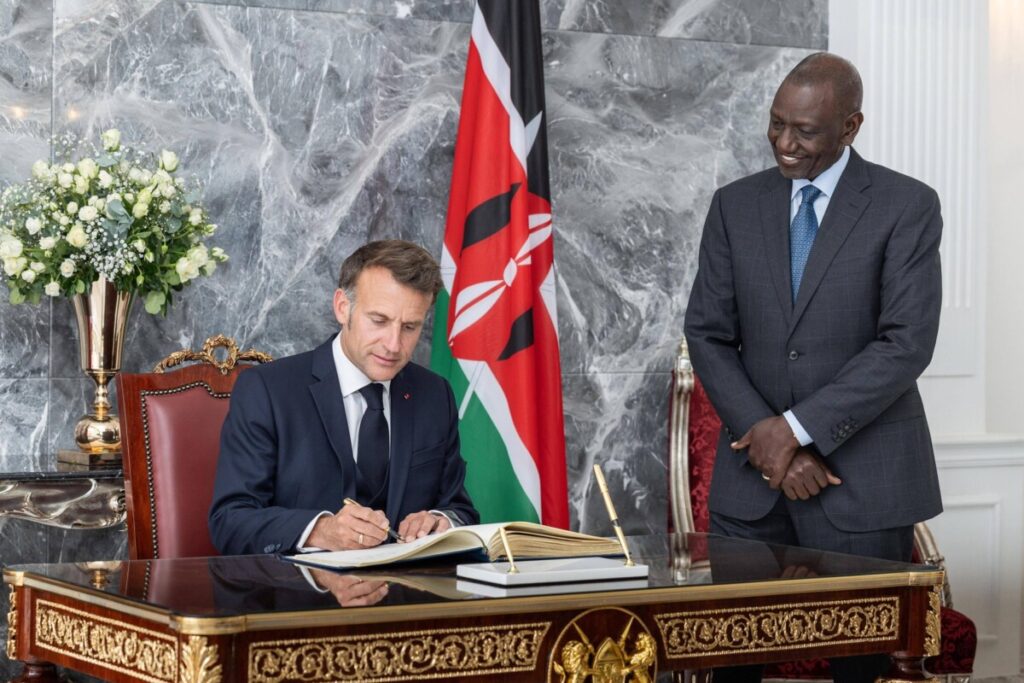
Africa Forward Summit has opened in Nairobi, bringing together policymakers, financiers and corporate leaders at the Kenyatta International Convention Centre (KICC) and the University of Nairobi for a two-day programme running from May 11 to 12, 2026. The gathering marks a shift in Franco-African relations, with a stronger focus on financial systems, capital flows and cross-border banking structures.
French President Emmanuel Macron and Kenyan President William Ruto are co-chairing the summit, which is being held in an Anglophone country for the first time since its inception in 1973. The platform has drawn more than 30 heads of state and government, including United Nations Secretary-General António Guterres, Nigerian President Bola Tinubu, Senegal’s President Bassirou Diomaye Faye, and business figures such as investor Aliko Dangote.
Franco-African Relations and Geopolitical Positioning
The Africa Forward Summit takes place against a backdrop of recalibrated Franco-African relations, with Paris seeking new financial and diplomatic channels following reduced influence in parts of the Sahel region. Ahead of the opening session, Macron and Ruto oversaw the signing of 11 bilateral agreements spanning energy, transport, digital infrastructure, agriculture and climate-related financing.
The discussions also serve as a preparatory coordination platform ahead of upcoming G7 engagements, where African positions on capital flows, debt structures and financial governance are expected to feature more prominently.
Banking and Financial Services Sector at the Centre
The banking and financial services sector is a core pillar of the agenda in the Africa Forward Summit in Nairobi, with a focus on reform of African Financial Infrastructure and the architecture governing cross-border capital flows. Central to the discussions is how African commercial banks access global liquidity and manage sovereign risk premiums that continue to influence lending rates.
A key policy direction is the restructuring of international financial frameworks to reduce the cost of capital across African markets. This includes proposals tied to sovereign debt rating mechanisms, regional risk-sharing instruments and the role of multilateral development banks such as the African Development Bank (AfDB) in expanding lending capacity through adjusted internal leverage limits.
The banking discussions at the Africa Forward Summit Platform also extend into transactional corporate banking and equity investment structures, aimed at increasing the flow of private capital into infrastructure and enterprise financing.
Private Capital Mobilisation and Institutional Pipelines
A major focus is the shift from aid-led financing models toward investment-driven structures linking global development finance institutions with African banks and firms. French development finance agencies Proparco and Bpifrance are expanding the “Choose Africa” framework, increasing credit lines and equity exposure to African financial institutions. The model channels capital through commercial banks and fintechs before reaching small and medium-sized enterprises across sectors such as agriculture, renewable energy and logistics.
More than 800 B2B enterprise matchmaking sessions are scheduled during the summit. These sessions are designed to convert infrastructure, green hydrogen and blue economy proposals into bankable projects that can be structured for syndicated lending and equity participation.
The agenda also includes discussions on Special Drawing Rights (SDRs) rechanneling mechanisms, with financial institutions examining pathways to redirect liquidity from advanced economies into African development institutions.
Fintech Expansion and Regional Payment Systems
Technology-driven financial integration is another key pillar, with venture capital funds and technology hubs operating under the Nova Garage Platform working to establish funding pipelines for fintech companies across the continent.
Regulatory panels are addressing cross-border payment systems, digital asset frameworks and settlement infrastructure. The objective is to reduce transaction costs and improve interoperability across retail and trade banking systems spanning Anglophone and Francophone currency zones. These discussions are increasingly linked to efforts to standardise digital financial infrastructure, enabling smoother capital movement between regional banking markets.
Jefferson Wachira is a writer at Africa Digest News, specializing in banking and finance trends, and their impact on African economies.