

Four Kenyan banks have made Forbes’ inaugural World’s Top Performing Banks 2026 ranking, among 500 banks assessed across 89 countries.
But unlike Forbes’ separate World’s Best Banks ranking, which is based largely on customer surveys, the new list is built around financial performance. Forbes developed the ranking with Statista using financial data, desk research and information submitted by banks.
That means appearing on the list requires more than simply being a large or well-known bank. A lender must first meet strict eligibility requirements before its financial performance is assessed across four areas: profitability, growth and earnings quality, capital and funding resilience, and asset quality and efficiency.
Which Kenyan Banks Made the Forbes 2026 Ranking?
The four Kenyan banks included in the Forbes World’s Top Performing Banks 2026 ranking are:
- Equity Group Holdings
- KCB Group
- Co-operative Bank of Kenya
- Stanbic Holdings
Reports on the ranking place Equity Group at No. 71, KCB Group at No. 79, Co-operative Bank at No. 120 and Stanbic Holdings at No. 138 within Forbes’ asset-size categories.
Forbes’ methodology means these positions are not simply a ranking of the biggest banks. Banks are first divided into asset-size groups, allowing institutions of broadly similar scale to be compared.
The First Test: A Bank Must Meet Forbes’ Eligibility Rules
Before Forbes scores a bank, the institution has to meet several basic requirements. It must be a licensed deposit-taking institution whose core business includes lending to retail or corporate customers. This covers institutions such as commercial, universal and wholesale banks.
The bank must also have more than $3 billion in assets, based on its most recently available full fiscal year. It must publish audited financial statements for that year and provide at least three consecutive years of financial data.
Forbes also requires banks to report under national accounting standards that can be reconciled for comparison purposes.
The $3 billion asset threshold is particularly important for understanding why only four Kenyan banks appeared on the list. A bank can have strong performance in a particular market but still be excluded if it does not meet Forbes’ minimum size and reporting requirements.
Once a bank qualifies, profitability accounts for 30% of its Forbes score, making it the largest individual component of the assessment.
Forbes considers several measures of financial performance, including return on average assets (ROAA), cost-to-income ratio and net interest margin. These indicators look at how effectively a bank generates returns from its assets, controls operating costs and earns income from its lending and other interest-generating activities.
This means a bank does not simply need to make a large amount of money. Its profitability is considered in relation to the resources it uses and the efficiency with which it operates.
Growth Must Also Come With Quality Earnings
The second component, growth and earnings quality, carries a 20% weight. Forbes considers factors including earnings growth and stability, as well as customer deposit growth indicators, generally using data covering three-year periods.
The focus is therefore not only on whether earnings have increased but also on the consistency and quality of that growth. A bank that produces stronger earnings while maintaining a stable funding base can therefore be assessed differently from one whose earnings growth is less consistent.
Banks operate by taking deposits and extending credit, making capital and funding a central part of their financial resilience.
Forbes assigns 25% of the score to capital and funding resilience. The assessment includes indicators such as the equity ratio and loan-to-deposit ratio. The measures are designed to provide an indication of how a bank is funded and how much capital it has available relative to its balance sheet.
For a bank, this matters because rapid loan growth alone does not necessarily indicate financial strength. The ability to support lending with an appropriate funding and capital structure is also part of the assessment.
Asset Quality and Efficiency Make Up Another 25%
The remaining 25% focuses on asset quality and efficiency. This part of the methodology considers credit quality, risk management and indicators of balance-sheet resilience.
Asset quality is particularly important for banks because loans represent a major component of their assets. Poor-quality loans can result in losses and increase pressure on capital. By including asset quality alongside profitability, growth and capital, Forbes’ methodology looks at several dimensions of a bank’s financial position rather than relying on earnings alone.
Why Bank Size Matters in the Forbes Ranking
Forbes divides qualifying banks into six asset-size tiers before the final comparison:
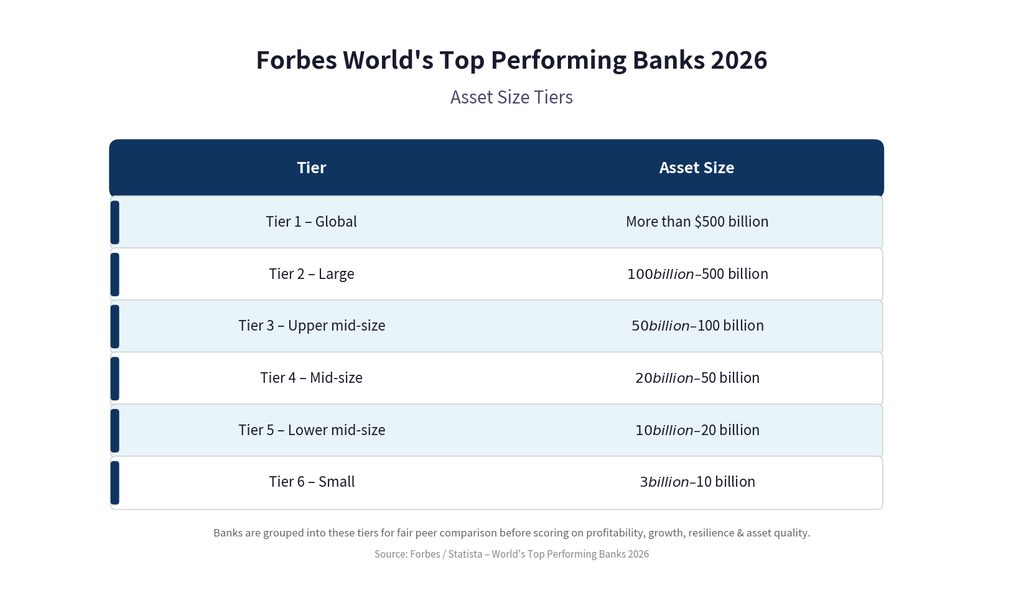
This structure is intended to make comparisons between banks of different sizes more meaningful. For example, Equity Group and KCB Group were placed in Tier 5, while Co-operative Bank and Stanbic Holdings were in Tier 6, according to reports on the 2026 ranking.