
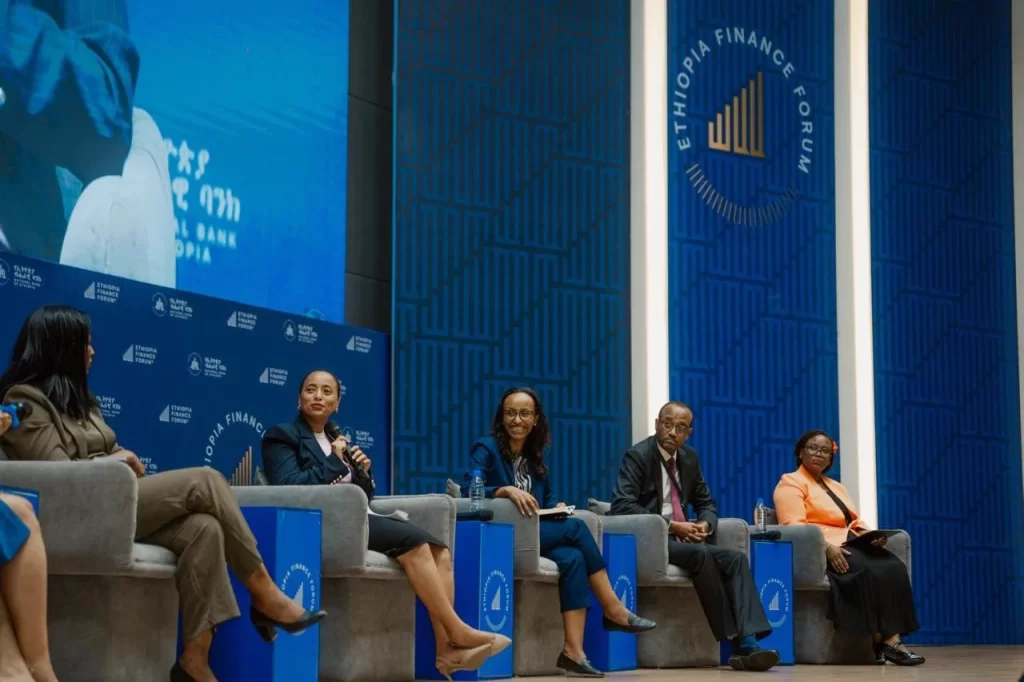
Ethiopia’s policymakers, bankers, investors and development partners gathered last week to map the next phase of the country’s economic reforms, declaring that the era of crisis management is giving way to one of results and structural change.
The Ethiopia Finance Forum 2026, convened by the National Bank of Ethiopia, ran from September 29 to October 1 at the Adwa Victory Memorial Museum in Addis Ababa. Under the banner “from reform/stabilization to results/transformation,” the three-day event centered on sustaining macroeconomic gains, expanding financial access, deepening markets and mobilizing capital for productive sectors.
Day 1 (September 29): Ethiopia launches finance forum with push from stabilization to transformation
Deputy Prime Minister Temesgen Tiruneh opened the Ethiopia Finance Forum 2026 by stressing that reforms must be judged by the opportunities they create. He called for broader access to finance for women, youth, farmers and micro, small and medium enterprises, deeper capital markets, stronger digital infrastructure, and greater mobilization of both domestic and international private capital. Long-term engagement, he said, must replace short-term fixes.
National Bank of Ethiopia Governor Eyob Tekalign delivered the keynote address titled “From Reform to Results.” He pointed to progress on macroeconomic stability, foreign-exchange reforms, financial inclusion and digital finance.
“Capability compounds when financed responsibly,” he said, outlining a 2026–2030 agenda built on four capital sources — public, financial sector, institutional and capital-market, and private/external — alongside seven macroeconomic “guardrails,” including price stability, fiscal and debt sustainability, external balance, domestic savings, financial stability, productivity and a competitive macro framework.
Tekalign also presented the central bank’s “One Bank, One Goal” plan and indicative 2030 targets, among them bringing inflation into single digits from a recent baseline of about 13.9 percent and raising financial inclusion. He noted that insurance penetration remains below 1 percent of GDP, with agricultural insurance covering less than 1 percent of the sector despite its large contribution to the economy.
A high-level panel that included Finance Minister Ahmed Shide, Planning Minister Fitsum Assefa, National Bank officials, and representatives from the International Monetary Fund and International Finance Corporation reviewed exchange-rate policy, monetary strategy, debt restructuring and financial-sector opening. Participants highlighted inflation’s decline from more than 26 percent to around 16 percent and the move toward a more market-based exchange rate.
The forum launched the draft National Financial Inclusion Strategy III for 2026–2030, which prioritizes deeper usage and higher-quality services for underserved groups while addressing data gaps, interoperability, regional and gender disparities, and risks around digital costs and fraud.
Parallel sessions examined agricultural finance architecture under the National Agricultural Finance initiative, skills development through the newly rebranded Ethiopia Academy of Finance, and a proposed dual-pillar housing-finance model combining a National Housing Fund with a Mortgage Refinance Company, potentially capitalized at around 100 billion birr with IFC involvement.
Day 2 (September 30): Foreign banks, gender inclusion and digital infrastructure take center stage
Day two focused on foreign strategic investment in banking, closing the gender gap in financial inclusion, digital public infrastructure, insurance-market reforms and deposit insurance. Officials discussed enabling foreign bank entry while protecting stability and securing technology transfer and capacity building.
The draft Insurance Proclamation and a proposed independent Ethiopian Insurance Regulatory Authority were presented as steps toward stronger consumer protection and market growth, including micro and agricultural insurance. The Ethiopia Deposit Insurance Fund’s mandate, compulsory membership and coverage rules were also outlined to bolster public confidence.
Day 3 (October 1): Interest-free finance, market infrastructure and closing vision round out forum
On the final day, organizers unveiled the draft National Interest-Free Finance Strategy for 2026–2030, covering governance, Takaful, potential Sukuk issuance, tax parity and Sharia oversight. Sessions also addressed financial-market infrastructure, foreign-exchange and capital-flow management under the more flexible regime, cyber resilience and emerging technologies.
In a closing fireside conversation, Governor Tekalign described reforms as a multi-chapter process requiring disciplined execution. He pointed to advances in flexible foreign exchange, quarterly monetary-policy decisions, expanded microfinance access for smallholders and rural women, and housing finance as priority areas. The goal, he said, is a more dynamic financial system that supports broader economic transformation.
The discussions targeted the financial sector itself — banking, microfinance, insurance, capital markets, payments and fintech — while aiming to channel resources into agriculture, housing, MSMEs, women and youth, and the digital economy. Many of the strategies presented remain drafts or proposals awaiting full implementation.
Organizers and participants framed the forum as confirmation that Ethiopia’s stabilization gains are being converted into deeper markets, wider inclusion and private-capital mobilization, with sustained collaboration among government, the private sector and international partners seen as essential to delivering measurable results.