
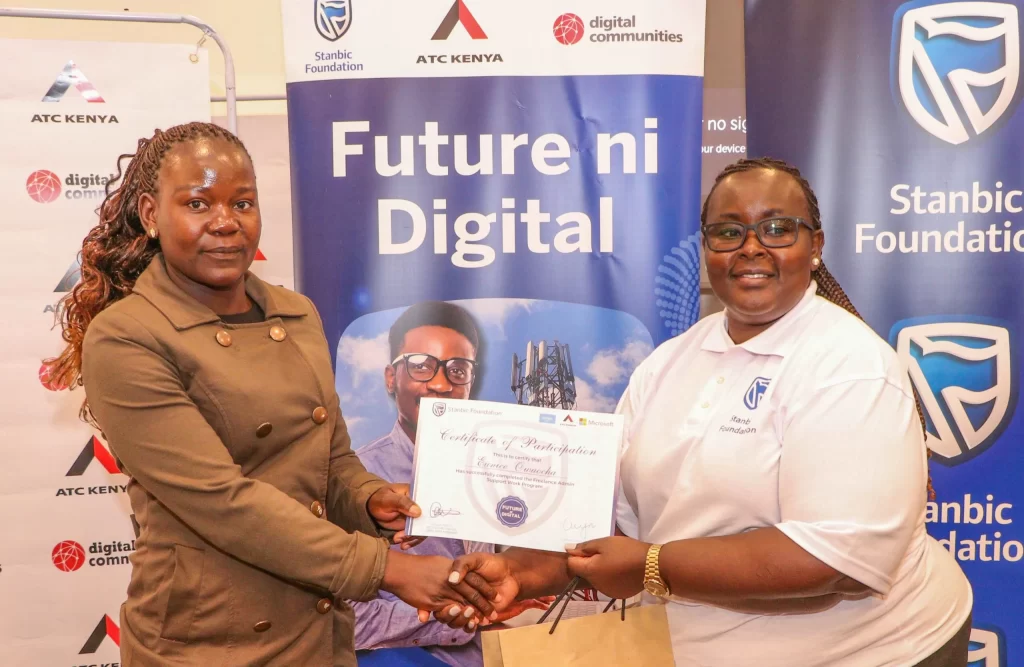
The Stanbic Kenya Foundation presents a structured approach to tackling some of the most persistent constraints facing Kenya’s economy, including limited access to finance for small businesses, low levels of formalisation, and a widening digital skills gap.
As the social impact arm of Stanbic Bank Kenya, the foundation has moved beyond traditional corporate philanthropy, focusing instead on interventions that link funding, skills, and market access. Its programmes are built around four pillars: enterprise development, education and digital literacy, health, and environmental sustainability.
Enterprise Development as the Core Focus
The Stanbic Kenya Foundation’s work is most visible in its enterprise development programmes, where the emphasis is on making MSMEs sustainable and eligible for financing.
A key challenge in Kenya’s informal sector is that many businesses operate outside regulatory frameworks, limiting their ability to access credit. The foundation addresses this by supporting business registration, tax compliance, and the adoption of structured accounting systems. This transition from informal to formal operations is often the first step toward unlocking growth.
Access to capital remains another constraint. Through its partnership with the United States African Development Foundation, the foundation provides blended financing which combines grants with loans, targeting underserved enterprises in sectors such as agriculture and manufacturing. Funding of up to $50,000 per business allows firms to scale operations while maintaining accountability. Beyond financing, the focus on market access is equally relevant. Connecting small businesses to established supply chains addresses a gap that funding alone cannot solve.
Digital Skills and the Future of Work
In education, the Stanbic Kenya Foundation has prioritised skills that align with labour market demand, particularly in digital fields. Its partnership with Microsoft and Kenya’s Ministry of Industrialization, Trade and Enterprise Development has enabled large-scale training in coding, data analysis, and digital marketing. The programme targets over 500,000 learners, with delivery supported through online platforms and physical “Smart Hubs” that provide access to internet and devices.
This approach recognises that access to infrastructure remains uneven, and that digital training requires both connectivity and equipment. The additional focus on training instructors ensures that the quality of teaching keeps pace with evolving technical requirements.
Targeted Health Interventions
The Stanbic Kenya Foundation’s health programmes are structured around specific interventions rather than general service delivery. Its cancer screening initiatives, conducted with partners such as the Roche Group and Gertrude’s Children’s Hospital, focus on early detection of breast, cervical, and prostate cancer. These are areas where access and awareness remain inconsistent.
During the COVID-19 period, support for facilities such as Kenyatta National Hospital included medical equipment and oxygen infrastructure, addressing capacity gaps in critical care.
Climate and Resource Efficiency
Under its environmental pillar, the Stanbic Kenya Foundation’s work is tied to practical business applications. Supporting companies to adopt solar energy and water recycling systems reduces operational costs while improving resource efficiency. Tree planting initiatives, particularly those focused on indigenous species, contribute to ecosystem restoration and water catchment protection, linking environmental sustainability with long-term economic stability.
A Blended Finance Approach to Social Impact
One of the distinguishing features of the Stanbic Kenya Foundation is its use of blended finance through a Social Impact Fund. The model, by combining grants with low-interest credit, introduces financial discipline while expanding access to capital.
This approach moves away from purely donation-based models, positioning beneficiaries as active participants in their own growth. It also allows capital to be recycled across multiple projects, increasing the reach of the programmes.
Linking Enterprise, Skills, and Growth
What stands out in the foundation’s model is the integration of its programmes. Enterprise development is supported by digital skills training, financing is paired with formalisation, and environmental initiatives are tied to business efficiency.
This structure addresses multiple constraints at once, rather than treating them as separate challenges. For Kenya’s MSME sector, where access to finance, skills, and markets often intersect, such an approach provides a more practical pathway to growth.
Jefferson Wachira is a writer at Africa Digest News, specializing in banking and finance trends, and their impact on African economies.