
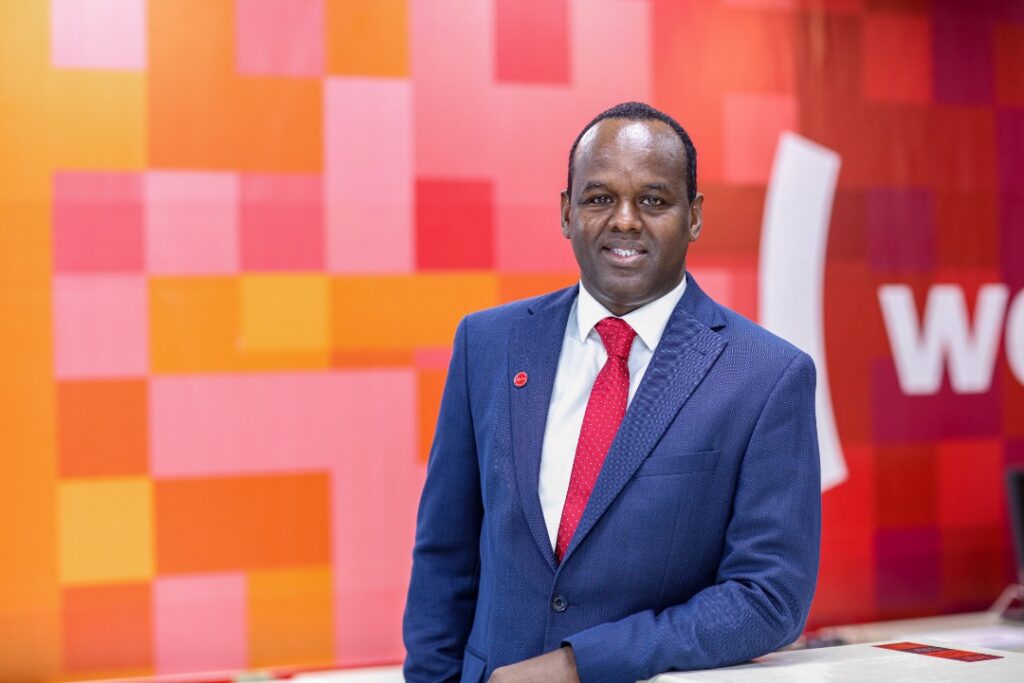
Absa Bank Kenya’s outgoing Chief Executive Officer Abdi Mohamed leaves behind a more diversified, profitable, and digitally focused lender after overseeing one of the bank’s most extensive operational transformations.
Mohamed took over leadership in May 2023 at a time when Absa was operating from a position of financial strength but remained largely dependent on interest income generated from lending. During his tenure, the bank expanded fee-based revenue, strengthened capital generation, improved credit quality and increased investment in digital infrastructure.
Shift from Interest Income to Transactional Banking
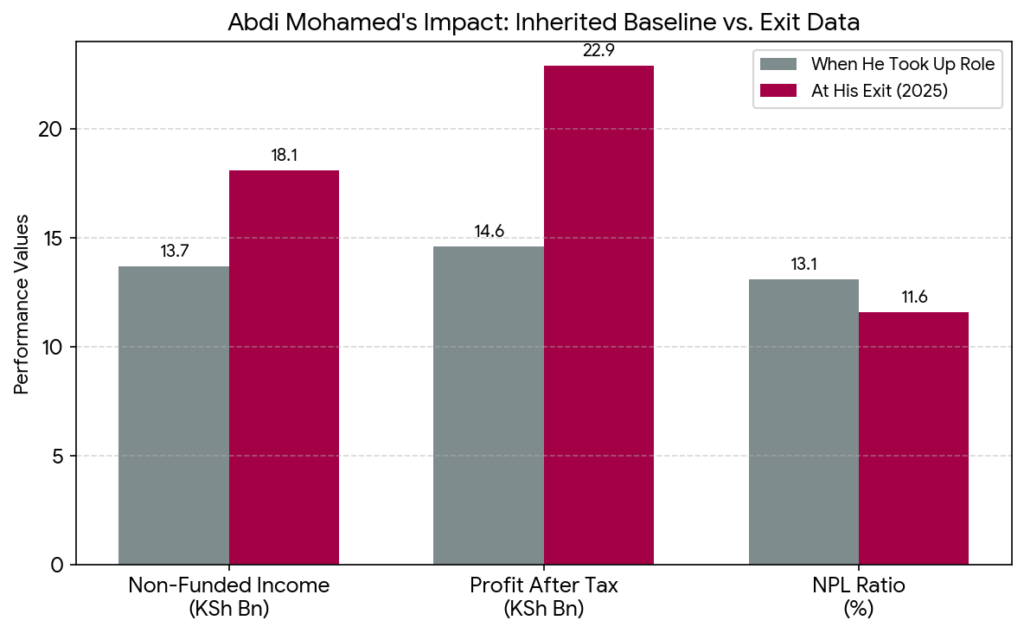
One of the defining features of Abdi Mohamed’s tenure was reducing the bank’s reliance on traditional lending income. Before his appointment, Absa Bank Kenya generated KSh 13.7 billion in non-funded income during the 2022 financial year. By the end of 2025, non-funded income had increased to KSh 18.1 billion, representing growth of about 32% over the period.
At the same time, the bank reduced its dependence on interest income by expanding transactional banking services, payments, bancassurance and wealth management offerings.
The lender also accelerated growth of its investment products. Its Unit Trust and Asset Management Scheme, which managed approximately KSh 1.5 billion in assets when Mohamed assumed office, expanded to become Kenya’s third-largest money market fund while the bancassurance business also recorded strong growth.
Higher Profits and Stronger Shareholder Returns
Financial performance improved steadily during Mohamed’s three-year leadership. When Abdi Mohamed became CEO, Absa had reported a full-year 2022 profit after tax of KSh 14.6 billion, customer deposits of KSh 304 billion and a dividend payout of KSh 1.35 per share.
By the end of the 2025 financial year, profit after tax had risen to KSh 22.9 billion, representing an increase of approximately 56.8% compared with the bank’s earnings before his appointment.
The lender also recorded stronger customer deposit growth, enabling the board to approve its highest dividend payout to shareholders. Operational efficiency improved during the same period as management streamlined expenditure and maintained one of the banking sector’s lowest cost-to-income ratios.
Improved Credit Quality amid Economic Pressures
Mohamed also oversaw changes to the bank’s credit risk framework as businesses and households navigated a challenging economic environment marked by higher borrowing costs and rising loan defaults across the banking industry.
Around the time he assumed office, Absa’s non-performing loan ratio stood at approximately 13.1%. By the end of 2025, the ratio had declined to 11.6%, despite continued pressure across the credit market.
Loan loss impairment charges also reduced substantially. Annual impairment provisions fell by about 32% to KSh 6.2 billion after the bank expanded the use of advanced credit assessment and risk monitoring systems, helping improve the overall quality of its loan portfolio.
Increased Investment in Digital Infrastructure
Technology became another major area of investment under Mohamed’s leadership. Rather than treating technology spending as a support function, Absa established a structured capital expenditure programme that allocated between KSh 2 billion and KSh 3 billion annually to digital infrastructure.
The investment upgraded core banking systems, expanded processing capacity and shifted more customer transactions to digital channels, reducing reliance on physical branches. Digital platforms, including Timiza, also evolved beyond basic retail transactions to support a wider range of consumer and business financial services.
Jefferson Wachira is a writer at Africa Digest News, specializing in banking and finance trends, and their impact on African economies.