
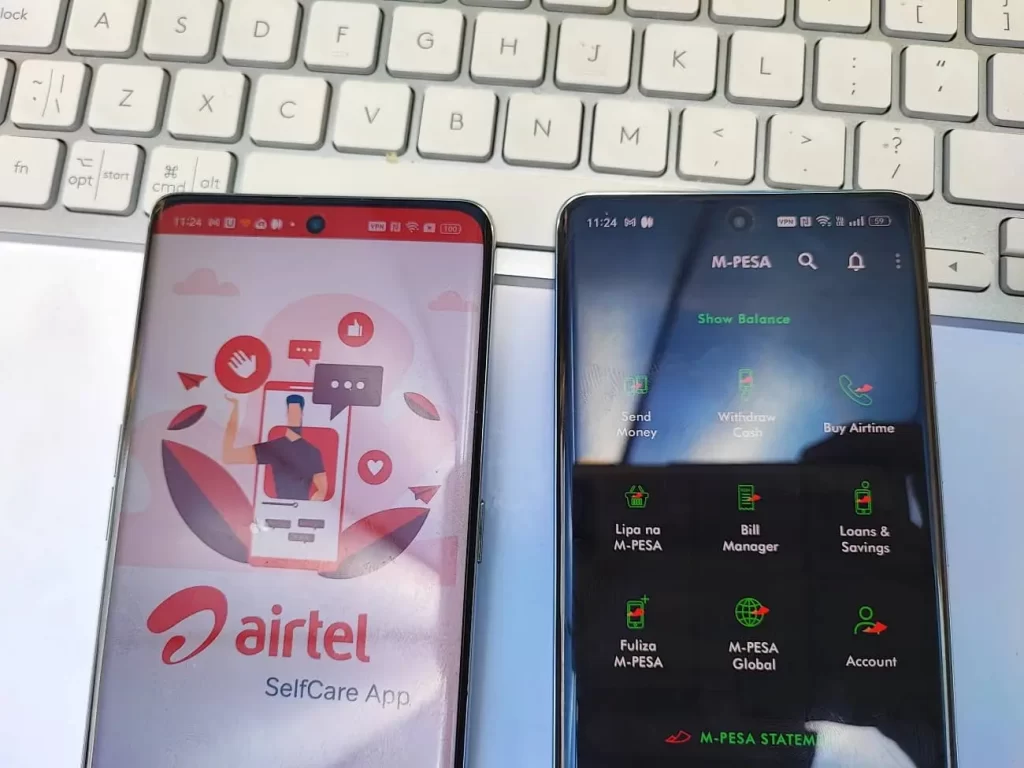
As East African consumers increasingly shop online and subscribe to global streaming and software services, two of the region’s dominant mobile-money players have taken sharply different approaches to virtual cards. Airtel’s Global Pay operates as a tightly controlled prepaid system, while Safaricom’s M-Pesa GlobalPay functions as a real-time pass-through linked directly to a user’s main wallet.
Two Architectures, Two Risk Profiles
Airtel Global Pay works as a distinct “sub-account.” Users must deliberately move money from their primary Airtel Money wallet into a separate virtual-card balance before any online purchase can succeed. Even if the main wallet holds TSh 100,000, the virtual card balance remains zero until an explicit transfer is made. When a merchant attempts a charge, the Mastercard gateway checks only that isolated balance.
M-Pesa GlobalPay takes the opposite approach. The virtual Visa card acts as a digital window into the core M-Pesa account. Whatever balance sits in the primary wallet is instantly available to spend. When a merchant bills the card, the Visa network pulls funds directly from the main mobile-money account in real time. There is no secondary balance to manage.
Fraud Mitigation: Damage Control vs. Active Controls
Security experts say the architectural difference becomes most visible when things go wrong.
In Airtel Global Pay, an unauthorized charge, whether from a rogue subscription that converts a free trial into a monthly fee or from a data breach that exposes card details, fails automatically if the user has not pre-loaded funds. The maximum loss is capped at whatever small amount was last transferred for a legitimate purchase. The primary savings remain untouched.
With M-Pesa GlobalPay, the same breach or subscription can repeatedly draw funds until the main wallet is empty. Safaricom mitigates this exposure through software controls inside its app: daily spending limits and the ability to freeze the card between purchases. Those controls work only if the user remembers to apply them. Forget to freeze the card, and the primary balance is fully exposed.
Convenience Comes at a Cost
The practical difference for everyday users ultimately comes down to friction. Airtel Global Pay requires several deliberate steps before a purchase can go through. Users must open the app, check exchange rates if needed, transfer the exact amount from their main Airtel Money wallet into the isolated virtual-card balance, and only then proceed to the merchant’s checkout page. That extra layer of effort slows the process but ensures no funds leave the primary wallet without conscious action.
M-Pesa GlobalPay, by contrast, removes almost all friction. Because the virtual Visa card is linked in real time to the main mobile-money account, customers can navigate straight to any online store or subscription page and complete the payment instantly. There is no secondary balance to fund and no intermediate transfer to manage.
This difference becomes especially clear with recurring charges. Airtel’s prepaid design is safe by default: a subscription or free-trial conversion simply fails unless the user has already moved money onto the card. M-Pesa’s pass-through model will allow auto-renewals to continue drawing from the primary wallet unless the customer remembers to freeze the card in the app.
Refunds follow the same pattern. Money returned to an Airtel virtual card stays in that separate balance until the user manually moves it back; M-Pesa refunds land directly in the main wallet without any additional step.
The convenience advantage of M-Pesa is obvious, until an unexpected charge appears. Airtel’s higher-friction approach trades speed for a built-in safeguard that keeps the bulk of a user’s savings insulated from the open internet.