
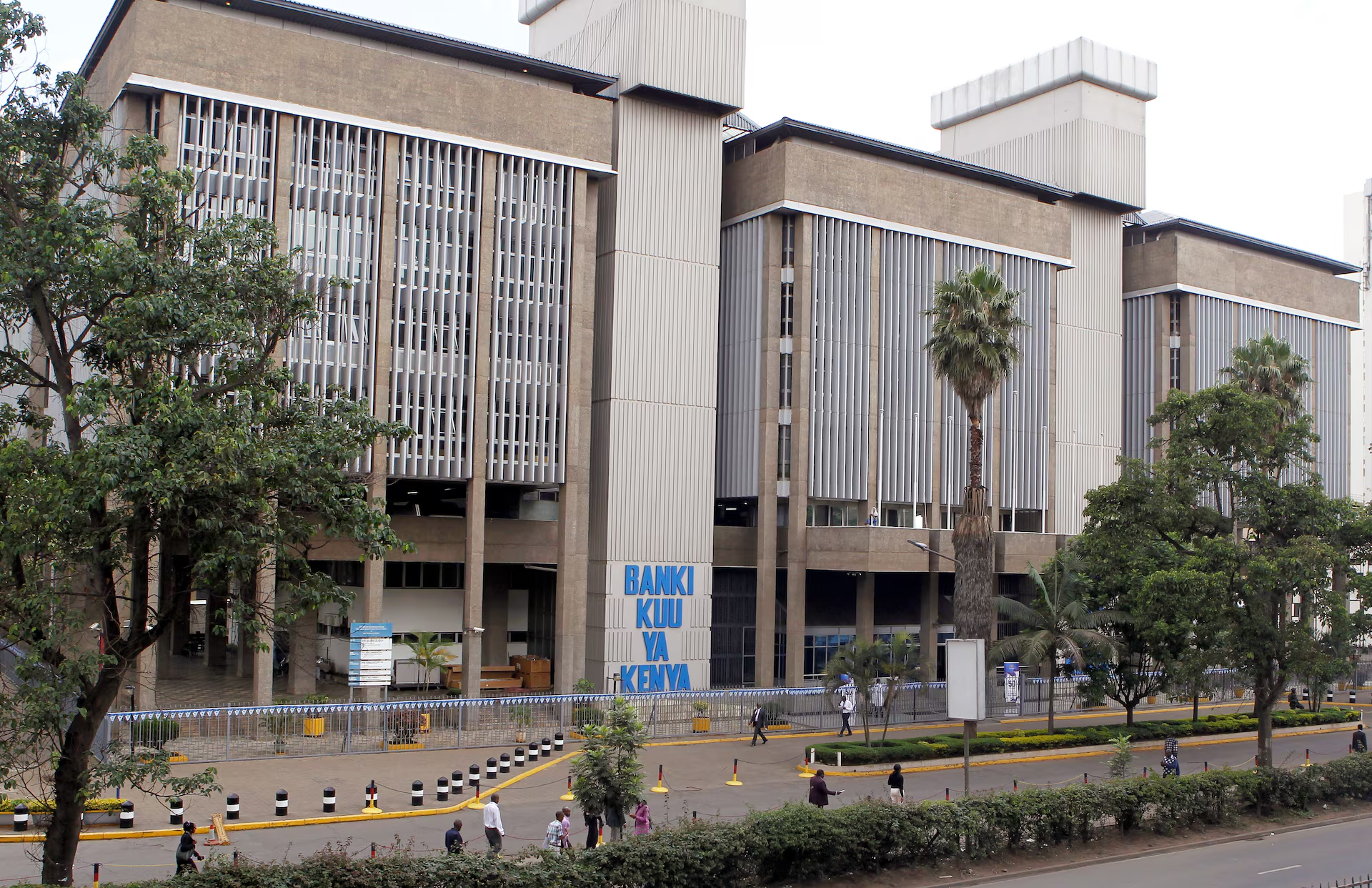
The Central Bank Rate (CBR) is the benchmark interest rate set by the Central Bank of Kenya (CBK). It currently stands at 8.75% and serves as the reference point for pricing loans across the banking sector. When the CBK adjusts this rate, it affects borrowing costs for households, businesses, and government borrowing conditions through commercial banks.
What is the CBK Base Rate (CBR)?
The CBK base rate, formally known as the Central Bank Rate (CBR), is the rate at which the Central Bank of Kenya lends money to commercial banks. It is set by the Monetary Policy Committee (MPC), which meets every two months to review inflation, liquidity conditions, exchange rate movements, and overall economic performance. The CBR is not just a technical figure. It is the main policy tool used by the CBK to influence inflation and economic activity. When inflation rises above the target range, the CBK may increase the rate to make borrowing more expensive. When economic growth slows, it may reduce the rate to encourage lending and investment.
Legal Mandate and Institutional Setup
The authority to set the CBK base rate is provided under Section 36 (4) of the Central Bank of Kenya Act. This legal framework requires the CBK to publish the minimum interest rate it charges commercial banks. The Monetary Policy Committee (MPC) is responsible for setting the rate. It is chaired by the CBK Governor and includes economic experts who assess financial and macroeconomic data before making policy decisions. Each adjustment in the CBR is used as a policy signal. A rate increase indicates tighter monetary conditions, often aimed at controlling inflation or stabilising the currency. A rate cut signals an easing stance intended to support borrowing and economic activity.
How the CBK Base Rate Works in the Banking System
One of the key channels the CBR influences the banking system is the discount window, where commercial banks borrow emergency funds from the CBK. The cost of borrowing from this facility is closely tied to the CBR, meaning changes in the base rate immediately affect liquidity costs for banks.
The CBK also uses Open Market Operations (OMO) to manage money supply. Through repurchase agreements, it either injects liquidity into the system or withdraws excess cash. These operations are priced around the CBR, making it a reference point for short-term funding conditions. In addition, the interbank market, where banks lend to each other overnight, is anchored by the CBR. The average interbank rate, tracked through KESONIA (Kenya Shilling Overnight Interbank Average), typically moves in line with the policy rate.
How Bank Loans Are Priced in Kenya
Commercial banks in Kenya price loans using a risk-based model that links directly to the CBR or KESONIA. The standard formula is:
Loan Interest Rate = CBR (or KESONIA) + Risk Premium (K)
The base component reflects the cost of funds determined by CBK policy. The premium, often referred to as “K”, covers operational costs and borrower-specific risk. This means borrowers are not charged a uniform rate. Instead, each customer’s final loan rate depends on both macroeconomic conditions and individual credit risk. A borrower with a strong credit history will pay a lower premium compared to one considered high-risk. As a result, even when the CBR is relatively low, average lending rates in Kenya can remain in double digits due to the added risk premium.
How Changes in the CBR Affect Borrowers
When the CBK lowers the CBR, commercial banks access cheaper funds. This typically leads to lower interest rates on new and existing variable-rate loans. Borrowers benefit through reduced monthly repayments, making credit more affordable for personal consumption, mortgages, and business expansion. Lower rates also tend to increase demand for loans as households and businesses take advantage of cheaper credit conditions.
When the CBK raises the CBR, borrowing becomes more expensive. Banks pass on higher funding costs to customers through increased loan interest rates. This raises repayment burdens and can reduce demand for new loans. In such periods, banks also tend to tighten lending standards, making credit harder to access, especially for higher-risk borrowers.
Transmission Channels: How the Policy Reaches the Economy
One way the impact of the CBR moves through the economy is through the credit channel, where changes in the base rate affect bank lending rates. Higher rates reduce borrowing and spending, while lower rates encourage credit uptake and investment. Another way is through the exchange rate channel. A higher CBR often attracts foreign investors seeking higher returns on Kenyan government securities such as Treasury Bills. This increases demand for the Kenya Shilling, helping stabilise its value. Lower rates may reduce such inflows, affecting currency pressure. Together, these channels influence inflation, consumption, and investment decisions across the economy.
Current Macroeconomic Context (2024–2026 Cycle)
The current CBR of 8.75% sits within a policy cycle that has seen multiple adjustments aimed at balancing inflation control with economic growth support. In earlier periods, the CBK maintained higher interest rates to manage inflationary pressure and stabilise the currency. As inflation conditions improved, the Monetary Policy Committee implemented a series of rate cuts, reducing the cost of credit across the economy.
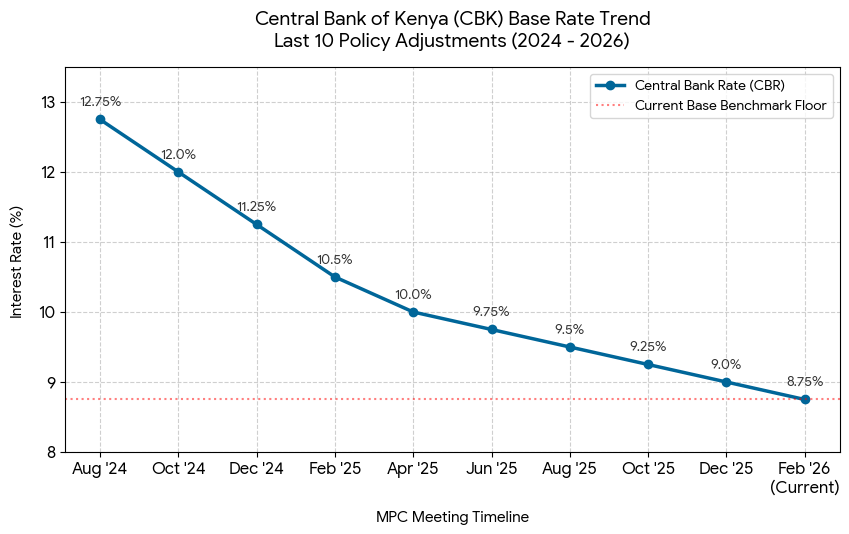
More recently, the MPC has paused further cuts to assess external risks such as global energy prices and supply chain disruptions, while keeping inflation within the target range of 2.5% to 7.5%. This pause gives policymakers time to evaluate how previous rate adjustments are affecting lending, consumption, and price stability.
Jefferson Wachira is a writer at Africa Digest News, specializing in banking and finance trends, and their impact on African economies.