
The ownership of NCBA Group PLC has long been concentrated among a small circle of Kenya’s most influential business families, many of whom built their fortunes through decades of involvement in the country’s banking sector.
That structure is now poised for its biggest transformation yet following a KES 110 billion takeover offer from South Africa’s Nedbank Group, a transaction that will hand the lender majority control of NCBA while still keeping the bank listed on the Nairobi Securities Exchange.
The Ndegwa family and the Kenyatta Family are the two powerful shareholder blocs in NCBA. Their rivalry for dominance inside the lender has intensified in recent years through aggressive share accumulation, positioning both groups as central players in one of Kenya’s most closely watched banking deals.
The current shareholding structure dates back to the 2019 merger between NIC Group and Commercial Bank of Africa (CBA), which created NCBA Group. The merger combined two institutions with deep ties to Kenya’s political and corporate elite.
The Ndegwa Family’s Rise to the Top
The Ndegwa family, led by James and Andrew Ndegwa, sons of former Central Bank of Kenya Governor Philip Ndegwa, currently holds the largest institutional stake in NCBA through First Chartered Securities. The investment vehicle owns about 246.1 million shares, representing a 14.94% stake in the lender.
The family’s influence traces back to NIC Bank, where the Ndegwas were among the founding controlling shareholders before the merger with CBA. Since the merger, the family has steadily increased its position through open-market purchases.
In 2023 alone, the Ndegwas purchased an additional 31.6 million shares in NCBA before adding another 9.35 million shares in early 2025. The acquisitions widened the gap between the family and other major shareholders, including the Kenyattas. Their increased position has made the Ndegwa family the largest institutional shareholder in NCBA ahead of the pending Nedbank acquisition.
The Kenyatta Family’s Banking Legacy
The Kenyatta Family remains one of the most influential shareholders in NCBA through Enke Investments Ltd and the personal holdings of Muhoho Kenyatta. The family’s banking roots stretch back decades through Commercial Bank of Africa, which was historically associated with the family before the 2019 merger. Enke Investments Ltd currently controls approximately 217.4 million shares, equivalent to a 13.2% stake in NCBA, making it the second-largest block in NCBA.
In May 2026, shareholder disclosures also identified Muhoho Kenyatta as the largest individual shareholder in NCBA. His direct and indirect holdings amount to about 227.3 million shares valued at roughly KSh 20 billion. Although the Kenyatta Family ceded the lead position to the Ndegwas in recent years, it remains among the bank’s most powerful shareholder groups.
Institutional Investors Still Hold Large Positions
Beyond the two dominant family blocs, several long-term institutional investors continue to hold sizeable stakes in NCBA. D&M Management Services LLP owns approximately 190.1 million shares, translating to an 11.54% stake. Brookshire Limited controls around 142.1 million shares or 8.63%, while Westpoint Nominees Limited holds about 126.7 million shares representing 7.69%.
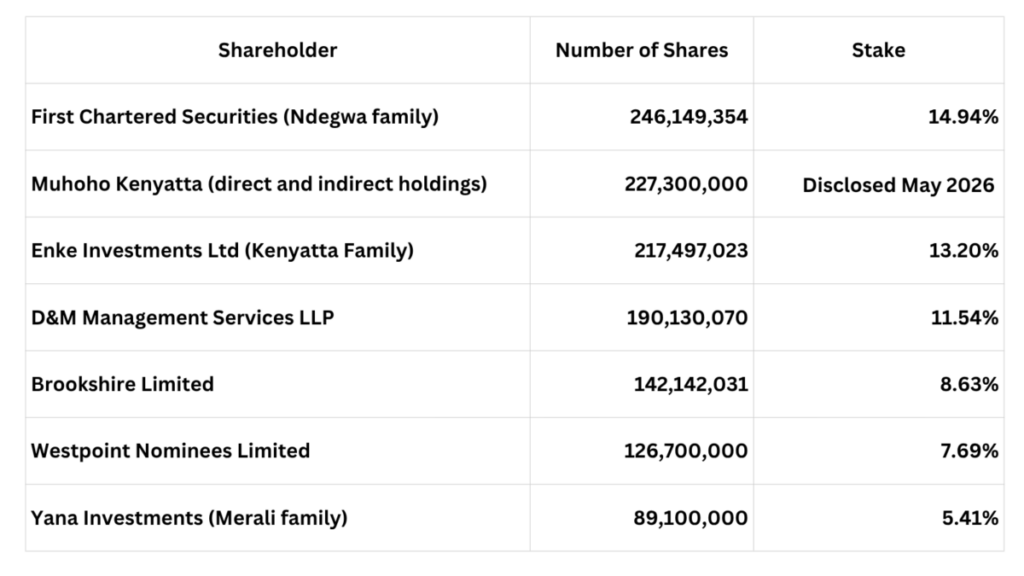
Yana Investments, linked to the Merali family, owns approximately 89.1 million shares in NCBA, equal to a 5.41% stake. The late Naushad Merali was widely known for his investments across banking, manufacturing and telecommunications.
How the Nedbank Deal Will Change Ownership of NCBA
The proposed acquisition by Nedbank will dramatically reshape the ownership of NCBA by giving the South African lender a 66% controlling stake. As of May 4, 2026, shareholders representing 77.54% of NCBA’s issued capital had already committed to accepting the offer, effectively securing the success of the transaction before final settlement.
Under the terms of the deal, small investors will receive KSh 105 per share for small investors in cash. Large NCBA shareholders such as the Ndegwa and Kenyatta families will instead receive a combination of cash and Nedbank shares listed on the Johannesburg Stock Exchange.
Once completed, NCBA will become a Nedbank subsidiary while maintaining its listing on the NSE with a 34% public free float. The structure allows existing public investors to continue trading NCBA shares while giving Nedbank operational control of one of East Africa’s largest lenders.
Jefferson Wachira is a writer at Africa Digest News, specializing in banking and finance trends, and their impact on African economies.