
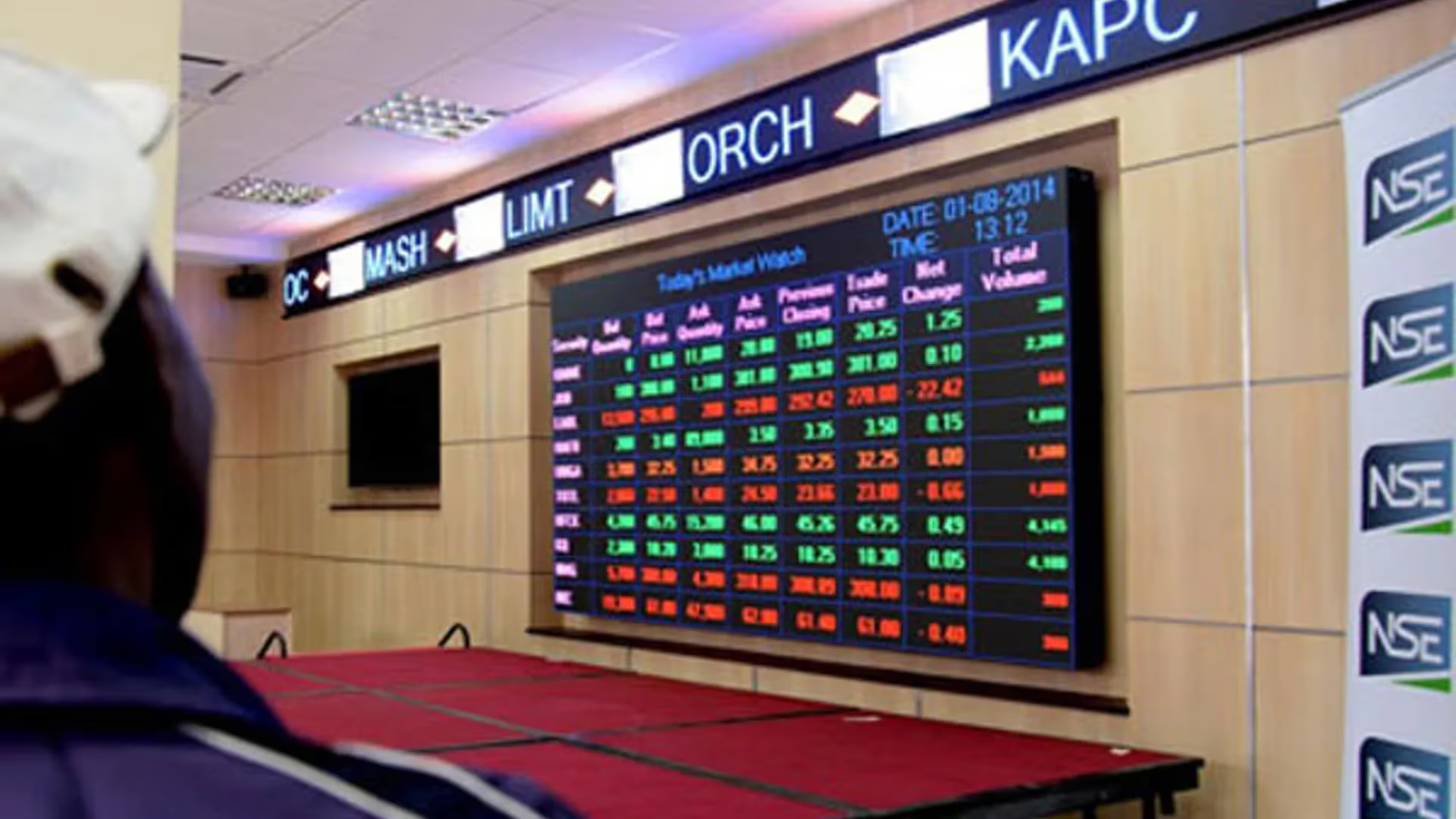
Picking bank stocks on the Nairobi Securities Exchange requires a mix of fundamental analysis and long-term investing, with attention to profitability, asset quality and management strategy. The approach has gained renewed focus since the launch of the NSE Banking Sector Index in late 2025, which provides investors with a benchmark tracking the performance of listed lenders.
As of the first quarter of 2026, banking shares have remained a central driver of market performance on the exchange. The banking index recorded a 5.59% gain in January alone, outperforming several other market benchmarks. The sector is dominated by large lenders such as Equity Group Holdings, KCB Group, Absa Bank Kenya and Co-operative Bank of Kenya, which continue to attract investor attention due to their scale, digital banking growth and lending to small businesses.
Evaluating Core Financial Metrics
Investors often begin by examining the internal financial indicators that determine how effectively a bank generates profit and manages risk. One of the most important measures is the net interest margin, which reflects the spread between interest income earned on loans and interest paid on deposits. A higher margin generally signals that the bank is managing lending rates and funding costs efficiently.
Asset quality is monitored through the non-performing loan ratio, which measures the share of loans that borrowers have failed to repay on time. Rising non-performing loans can signal growing credit stress in the economy, while lower ratios suggest stronger risk management within the bank.
Operational efficiency is measured through the efficiency ratio, often referred to as the cost-to-income ratio. A lower figure indicates that the institution is spending less to generate revenue. Many investors consider a ratio near or below 60% a sign of disciplined cost management.
Return on equity is another critical indicator because it shows how effectively a bank converts shareholder capital into earnings. Investors generally prefer lenders that maintain consistent returns above 10%, which signals that the bank is generating sustainable profits from its equity base.
Valuation metrics also play a role in investment decisions. Price-to-book ratios are widely used in banking analysis because they compare a bank’s market value to its balance sheet equity. Lower valuations relative to book value may indicate potential upside if the bank’s profitability remains strong.
Dividend and Yield Strategies
Dividend income remains one of the primary reasons investors buy banking stocks on the Nairobi exchange. Many Kenyan lenders have long records of paying regular dividends, providing shareholders with steady cash flow even during periods of market volatility.
Banks such as Co-operative Bank, Absa Bank Kenya and Standard Chartered Bank Kenya are often followed closely by income-focused investors because of their consistent dividend track records. In early 2026, Absa Bank Kenya announced a final dividend of KES 1.85 per share, adding to its appeal among investors seeking stable yields.
Investors also evaluate payout ratios, which measure the proportion of profits distributed as dividends. Higher payout ratios can deliver stronger income streams but may leave less capital available for expansion or new investments.
Monitoring Growth and Digital Transformation
Growth prospects remain a central factor when selecting bank stocks on the NSE. Much of the sector’s expansion in recent years has been driven by digital banking adoption, regional expansion and lending to small and medium-sized enterprises.
Large lenders such as Equity Group and KCB Group have invested heavily in digital banking platforms and fintech partnerships, allowing them to reach millions of customers through mobile and online channels. These strategies help banks expand their customer base while keeping operating costs relatively low.
Investors also monitor consolidation activity and strategic acquisitions within the sector. Corporate developments, such as potential mergers or fintech investments, can influence share prices and shift competitive dynamics among banks.
Monitoring Warning Signs in Bank Performance
Despite the sector’s strong performance, investors still watch several warning signs that could signal financial stress. A rapid increase in non-performing loans may indicate deteriorating credit quality, particularly if the trend is linked to sectors facing economic pressure.
A shrinking net interest margin may also raise concerns because it suggests that funding costs are rising or competition is forcing banks to lower lending rates. In addition, banks that rely heavily on expensive wholesale funding instead of stable customer deposits may experience greater earnings volatility.
Technical Indicators and Market Timing
Valuation levels and market sentiment also influence investment decisions. In recent months, the banking sector has traded at a price-to-earnings ratio of roughly 7.8 times earnings, a discount compared with historical averages that some analysts interpret as a sign of potential value.
Momentum indicators also play a role. By February 2026, the NSE Banking Sector Index had reached an all-time high of 237.12, showing strong investor interest in the sector. The exchange has also introduced futures linked to the banking index, allowing investors to hedge against sector-specific risks.
A Long-Term Investment Approach
Bank stocks on the NSE are often treated as long-term investments rather than short-term trading opportunities. Investors typically hold these shares for several years in order to benefit from both dividend payments and capital appreciation.
Market downturns can present opportunities to accumulate shares of high-quality banks at lower valuations. Historical performance on the exchange shows that patient investors who bought during periods of market weakness often achieved stronger long-term returns.
Tracking the Banking Index
The launch of the NSE Banking Sector Index has provided investors with a clearer view of the sector’s overall performance. The benchmark tracks the shares of eleven listed banks and allows market participants to compare the performance of individual lenders with the broader industry trend.
Jefferson Wachira is a writer at Africa Digest News, specializing in banking and finance trends, and their impact on African economies.