

Standard Bank Group is increasing its focus on Kenya as it seeks to expand its presence in East Africa, targeting the country’s growing financial services, infrastructure, trade and digital economy while positioning Stanbic Bank Kenya to become the country’s largest lender by 2030.
The South African banking group plans to double Stanbic’s retail footprint by 2029 as it shifts the Kenyan subsidiary from its traditional strength in corporate and investment banking towards a larger retail and small and medium-sized enterprise (SME) business.
The expansion comes as Standard Bank seeks greater exposure to higher-growth African markets while South Africa continues to experience slower economic growth.
Kenya as East Africa’s Financial Gateway
Kenya’s importance to Standard Bank extends beyond its domestic banking market. Nairobi is a major centre for financial services, trade and multinational companies operating across East Africa. This gives Stanbic access to corporate and trade flows involving Uganda, Tanzania, Rwanda, South Sudan, Ethiopia and the Democratic Republic of Congo.
The regional connection creates opportunities in transaction banking, cross-border payments, trade finance, investment banking and corporate lending. Kenya’s infrastructure pipeline adds another source of business. Investment in roads, energy, ports, manufacturing and real estate requires project finance, debt financing and advisory services.
Stanbic has participated in major transactions in the country, including financing linked to the Nairobi Expressway. It has also been involved in regional deals, including a $1 billion syndicated facility for the Eastern and Southern African Trade and Development Bank and a $25.9 million green commercial development project for CCI Global in Tatu City.
Strong H1 Results Provide a Larger Expansion Base
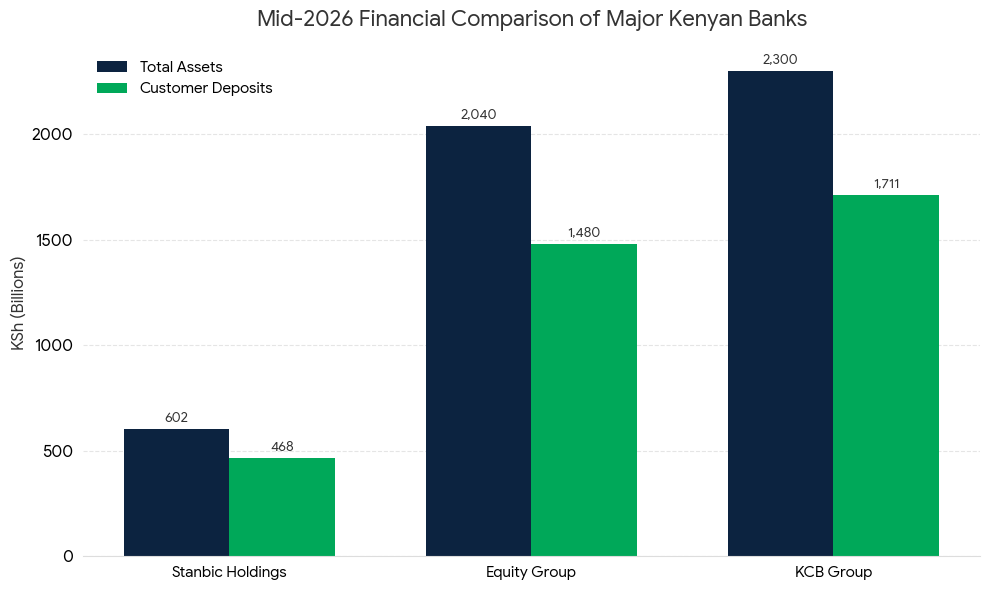
Stanbic’s latest financial results show the scale of the Kenyan business as it enters the next phase of expansion. Stanbic Holdings PLC’s total assets increased 27% to KSh602.18 billion in the first half of 2026, taking the bank’s balance sheet above the KSh600 billion mark.
Customer deposits grew by 33.4% to KSh467.47 billion, while net loans and advances increased 16.7% to KSh360.16 billion. The bank also reported a 50.2% decline in credit impairment charges to KSh724.97 million and recorded KSh6.61 billion in net profit after tax for the six months.
The deposit growth is particularly relevant to the bank’s retail strategy. Stanbic had about 322,000 customer accounts against KSh467.47 billion in deposits, leaving room to broaden its customer base beyond its established corporate and institutional relationships. Its retail expansion is expected to increase the number of everyday banking customers while adding to deposits and supporting consumer and SME lending.
From Corporate Banking to Retail and SMEs
Stanbic has historically built its Kenyan business around corporate and investment banking, serving large companies, institutions and investors through capital markets, trade finance, advisory and transaction banking.
The new strategy places greater emphasis on individual customers and SMEs. The bank plans to increase its physical presence from about 40 branches and complement the expansion with agency banking and digital channels.
Kenya’s high adoption of mobile financial services provides a platform for this strategy. Widespread use of mobile money and digital payments has created consumers accustomed to accessing financial services through mobile channels, while businesses increasingly use digital platforms for payments and banking.
For Stanbic, the expansion provides an opportunity to combine its existing corporate franchise with a larger retail and SME customer base.
Infrastructure and Trade Corridors
The bank’s corporate business remains central to its Kenyan strategy. Kenya’s role as a regional transport and trade hub connects businesses to markets across East and Central Africa. This creates demand for trade finance, foreign exchange, cash management and cross-border payment services.
Stanbic also benefits from Standard Bank Group’s wider African network and its relationship with Industrial and Commercial Bank of China (ICBC), the group’s largest shareholder. The relationship provides exposure to China-Africa trade and investment flows, including companies involved in infrastructure and other capital-intensive projects.
Targeting Kenya’s No. 1 Position
Standard Bank has set a target of making Stanbic Kenya the country’s largest bank by 2030. The lender is currently outside the top five by market size, according to the information provided, meaning the target will require substantial growth in customers, deposits, lending and distribution.
Organic expansion is one component of the plan. Standard Bank has also indicated that it is evaluating potential acquisitions of Kenyan banks where there is a suitable cultural and business fit. Acquisitions could provide additional branches, customers, deposits and lending assets, complementing Stanbic’s planned retail expansion.
The bank’s strategy also includes financial targets at group level, including annual earnings-per-share growth of 8% to 12%, a 23% to 25% return on equity target and revenue growth of 14% to 16%.