
For anyone watching the Kenyan shilling, one number has become unusually familiar: KSh 129 for one US dollar. The shilling has remained remarkably close to the KSh 128–130 range since around August 2024, after recovering sharply from its record weakness earlier that year. As of September 24, 2026, the Central Bank of Kenya (CBK) quoted the dollar at KSh 129.48.
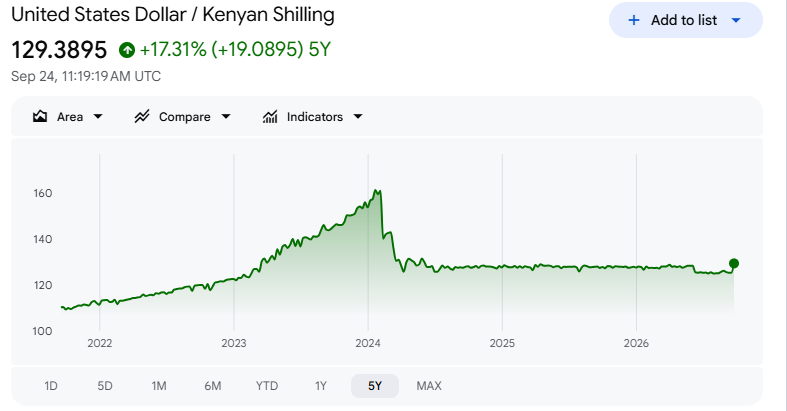
That means the shilling has spent more than two years moving within an exceptionally narrow range against the dollar. So, what is keeping the dollar around KSh 129? Is the shilling really being allowed to float freely? And has this happened before?
How Kenya’s shilling went from KSh 160 to KSh 129
The current stability looks very different from what happened before it. In early 2024, the Kenyan shilling was under intense pressure. The exchange rate moved above KSh 160 to the dollar, after a difficult 2023 in which the currency had depreciated sharply.
The situation changed rapidly during 2024. As external financing pressures eased, confidence improved and foreign-exchange reserves began rebuilding. The shilling recovered from its January 2024 lows and reached the KSh 129 area later in the year.
The IMF said in October 2024 that the resolution of exceptional external financing pressure had helped restore market confidence, stabilise the shilling and accelerate the rebuilding of foreign-exchange reserves. Since then, however, the recovery has largely stopped around the KSh 129 level.
Why has the dollar stayed around KSh 129?
There is no single reason why the dollar has stayed around Ksh 129. The stability reflects a combination of stronger foreign-exchange inflows, improved reserves, changes in Kenya’s external position and the way the CBK operates in the foreign-exchange market.
The CBK itself says Kenya operates a market-determined exchange-rate system. It says it does not defend a particular value of the shilling, but can intervene when necessary to smooth excessive volatility.
That distinction is important. A currency can have a flexible exchange-rate regime while the central bank still buys or sells foreign currency to reduce sharp movements. And Kenya’s foreign-exchange reserves give the CBK room to do that.
The CBK has a large dollar cushion
Kenya’s foreign-exchange reserves have become one of the main buffers behind the shilling’s stability. In August 2026, CBK reported reserves of about $15.25 billion, equivalent to 6.3 months of import cover. That was comfortably above the statutory minimum of four months.
Those reserves matter because they give the central bank capacity to supply dollars to the market when there is unusually strong demand.
But reserves can also rise when the CBK buys dollars. CBK explains that foreign-exchange transactions can be used to build reserves and that intervention can be used to smooth erratic exchange-rate movements. This creates an important part of the story behind the KSh 129 level.
If dollar supply becomes particularly strong and the shilling starts appreciating rapidly, buying dollars can increase reserves while reducing the pace of appreciation. In other words, the central bank does not necessarily have to be trying to defend KSh 129 for its actions to help keep the currency near that level.
Kenya is still receiving billions of dollars from abroad
The supply of foreign currency has also improved. Diaspora remittances remain one of Kenya’s most important sources of dollars. CBK reported remittance inflows of $436.6 million in July 2026, while cumulative inflows over the preceding 12 months stood at about $4.99 billion.
Kenya also earns foreign currency through exports of goods such as tea, coffee and horticultural products, as well as tourism and other services. These inflows increase the supply of dollars available to the economy.
That’s why the shilling has been able to remain around KSh 129 even while Kenya continues to import large quantities of fuel, machinery, manufactured goods and other products that require foreign currency.
So is the CBK deliberately keeping the shilling at KSh 129?
The CBK’s position is that the shilling is market-driven. Governor Kamau Thugge and the central bank have repeatedly rejected the idea that the exchange rate is administratively fixed. The CBK says it intervenes to smooth excessive volatility rather than to maintain a predetermined exchange rate.
But some Kenyan officials and analysts have described the situation differently. National Treasury Cabinet Secretary John Mbadi has previously said the shilling could be considerably stronger if it were allowed to trade without the same level of dollar purchases by the authorities.
Mbadi said the shilling could move toward KSh 118 per dollar and argued that excessive appreciation would hurt exporters.
Why the KSh 128–130 range is unusual
The current period is unusual because Kenya does not operate a conventional fixed exchange rate. Under a fixed or formally pegged currency system, authorities explicitly maintain a particular exchange rate or narrow band. Kenya’s current system is different. Yet the shilling has moved remarkably little against the dollar.
The Parliamentary Budget Office described the period from June 2024 to December 2025 as unusually stable, with the exchange rate fluctuating narrowly around KSh 129. It said the pattern pointed to tight exchange-rate management or active liquidity smoothing, while also noting that the stability had helped make dollar-denominated debt servicing more predictable.
There is another interesting detail. The shilling has not been equally stable against every major currency. While the dollar rate has remained close to KSh 129, the shilling has moved more noticeably against the pound and euro. Parliamentary analysis highlighted this difference.
What about the IMF’s concern that the shilling is “too stable”?
The unusual stability has attracted attention from the International Monetary Fund. The issue is not simply whether a stable exchange rate is good or bad. The concern is about how the exchange rate is being kept stable and whether unusually limited movements could interfere with the way monetary policy and external imbalances adjust.
Kenyan officials have pushed back against the idea that the stability is artificial, pointing instead to stronger foreign-exchange inflows, reserves and improved economic conditions. The Parliamentary Budget Office has also noted the possibility that the calm exchange rate could conceal underlying foreign-exchange imbalances.
Has Kenya ever kept the shilling this stable for so long?
Not under the modern floating or managed-floating system in anything resembling the current circumstances. There were much longer periods of exchange-rate stability when Kenya operated under fixed or pegged exchange-rate arrangements.
But that was a fundamentally different system. Under a peg, the authorities explicitly maintained the currency around a defined value. Today’s system is formally flexible.