

Ethiopia will lift its long-standing bank lending cap in September 2025, unlocking an estimated 1.3 trillion birr ($10.8 billion) in credit. The policy change represents a 500 billion birr increase from last year’s lending volume and marks a major shift from restrictive measures that have constrained bank loans in Ethiopia for nearly four years. The easing of the lending cap in Ethiopia, announced by the Ministry of Finance and the National Bank of Ethiopia (NBE), is intended to support growth in manufacturing, construction, and agriculture while improving household access to financing.
Origins of the Lending Cap
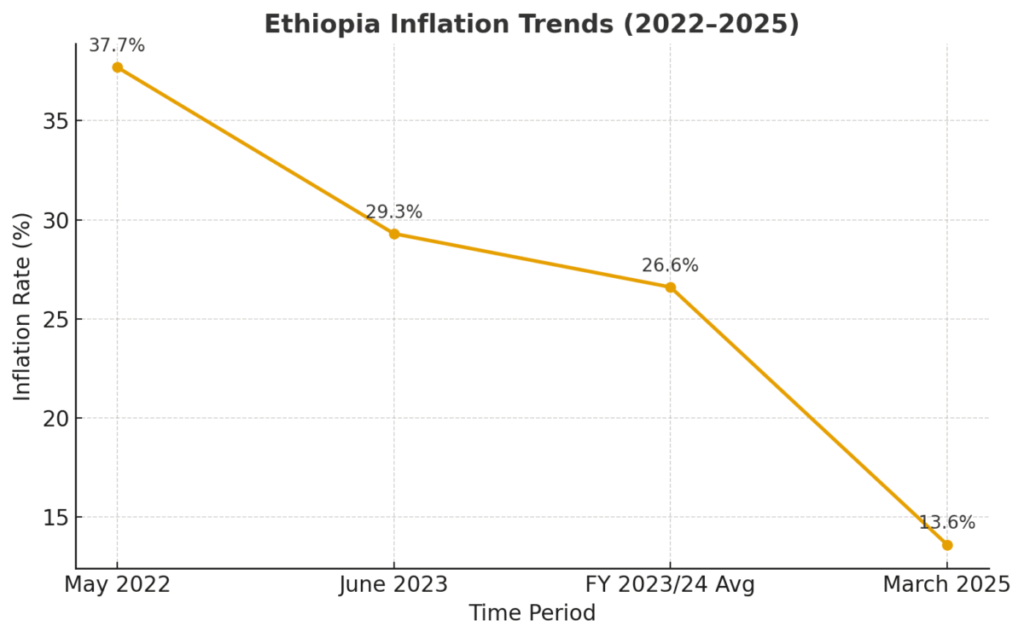
Ethiopia’s bank lending cap was first introduced in August 2021, when the NBE limited annual credit growth at commercial banks to 14%. The measure was later adjusted to 18% in 2024. Authorities acted to contain double-digit inflation after bank loans surged by 382 billion birr in 2023, contributing to an expansion in money supply that drove inflation to 29.3% in June of that year.
While the cap succeeded in moderating price growth, with inflation easing to 13.6% by March 2025, it curtailed credit to businesses and households. Companies in manufacturing, construction, and agriculture struggled with financing bottlenecks, while consumers faced limited access to personal and housing loans.
Policy Rationale and Reform Agenda
The removal of Ethiopia’s lending cap aligns with the country’s Homegrown Economic Reform (HGER) Agenda, launched in 2019 and expanded in 2024. The program is designed to transition the country toward a market-based financial system, attract private investment, and reach middle-income status by 2030.
- Ethiopia Omitted from World Bank’s 2025–2026 Income Classification
- Could Ethiopia’s Banking Upgrade Set a New Standard for Africa?
The International Monetary Fund (IMF) has backed the reform, noting that easing restrictions on lending is a prerequisite for market-driven credit allocation. However, it has cautioned against financial instability, urging the authorities to strengthen supervision and implement inflation-control mechanisms.
Sectoral Impact of the Credit Expansion
The injection of 1.3 trillion birr into the economy is expected to have wide-ranging effects.
- Manufacturing: Export-oriented factories and industrial parks have been hit by foreign exchange shortages and tight credit conditions. Additional lending could help businesses import raw materials, upgrade equipment, and expand production, contributing to export growth.
- Construction: The sector has faced financing shortfalls that delayed major projects, including highways under the Ethiopian Roads Authority and real estate developments in Addis Ababa. New credit availability is expected to restart projects, create jobs, and stimulate industries such as cement and steel.
- Agriculture: As the largest employer in the country, agriculture will gain access to financing for mechanized farming, irrigation, and fertilizer. Expanded credit could boost productivity and improve food security.
- Households: Consumers are expected to benefit from easier access to personal loans and mortgages. The Commercial Bank of Ethiopia (CBE), which controls over 50% of bank deposits and loans, has already adjusted lending rates for commercial, agricultural, and personal credit in anticipation of the policy change.
Inflation Risks and Monetary Safeguards
Ethiopia continues to struggle with high inflation, driven by currency depreciation and supply shocks. Since adopting a floating exchange rate in 2024, the birr has lost more than 100% of its value against the U.S. dollar. Inflation is projected to peak at 25% by mid-2025, raising concerns that Ethiopia’s 1.3 Trillion Birr Credit Expansion could fuel new demand-driven price pressures.
Finance Minister Eyob Tekalign has emphasized that “prudent monetary oversight” will be critical to preventing overheating. The NBE has outlined a framework to mitigate risks, which includes:
- Phased Liquidity Injections – Credit will be released gradually, with the NBE conducting biweekly open market operations to manage money supply.
- Stricter Reserve Requirements – Banks will be required to hold a larger portion of deposits as reserves to ensure stability. Differentiated ratios may apply, with lower reserves for “green and productive” sectors such as sustainable agriculture, and higher ratios for inflation-sensitive lending such as consumer credit.
- Interest-Based Monetary Policy – A 15% policy rate has been set to anchor inflation expectations. By adjusting this rate, the central bank can influence borrowing costs and lending activity.
- Enhanced Monitoring and Supervision – The NBE will closely monitor banks’ loan portfolios, paying particular attention to credit quality and non-performing loans (NPLs). Ethiopia’s NPL ratio stood at 5.6% in 2021–22, underscoring the need for careful oversight.
Mechanisms for Implementation
The NBE has confirmed that from September 2025, commercial banks will no longer be constrained by a fixed credit growth ceiling. Instead, lending decisions will be based on banks’ capital, liquidity, and risk assessments. To manage liquidity across the system, the central bank is introducing an electronic interbank money market, allowing banks to borrow from one another more efficiently.
The central bank’s newly established monetary policy committee will also conduct regular stress tests, audits, and data reviews to ensure lending expansion does not compromise financial stability. According to NBE officials, banks will be required to provide more detailed reporting on loan disbursement and sectoral allocation, allowing regulators to track credit flows in real time.
Jefferson Wachira is a writer at Africa Digest News, specializing in banking and finance trends, and their impact on African economies.